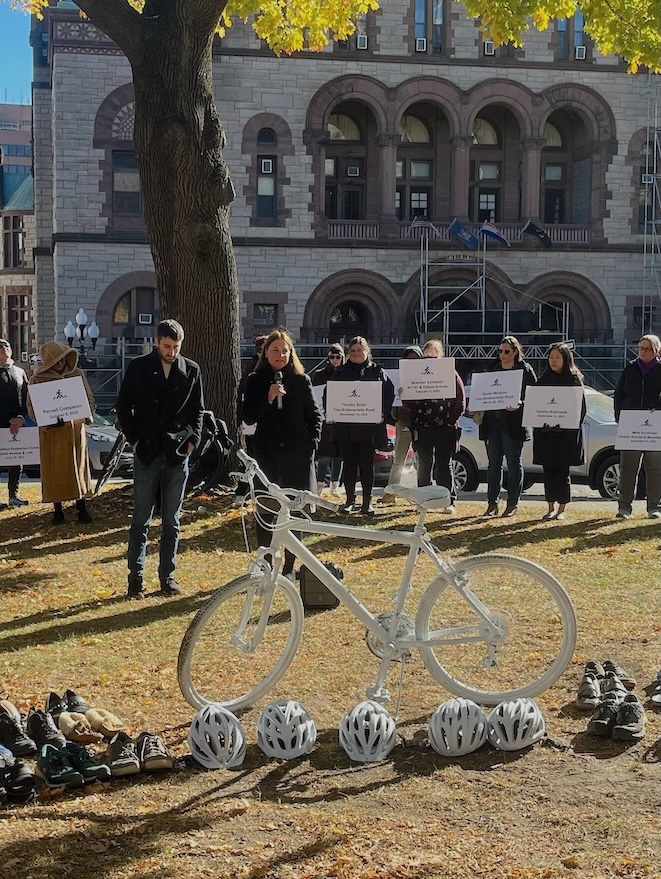
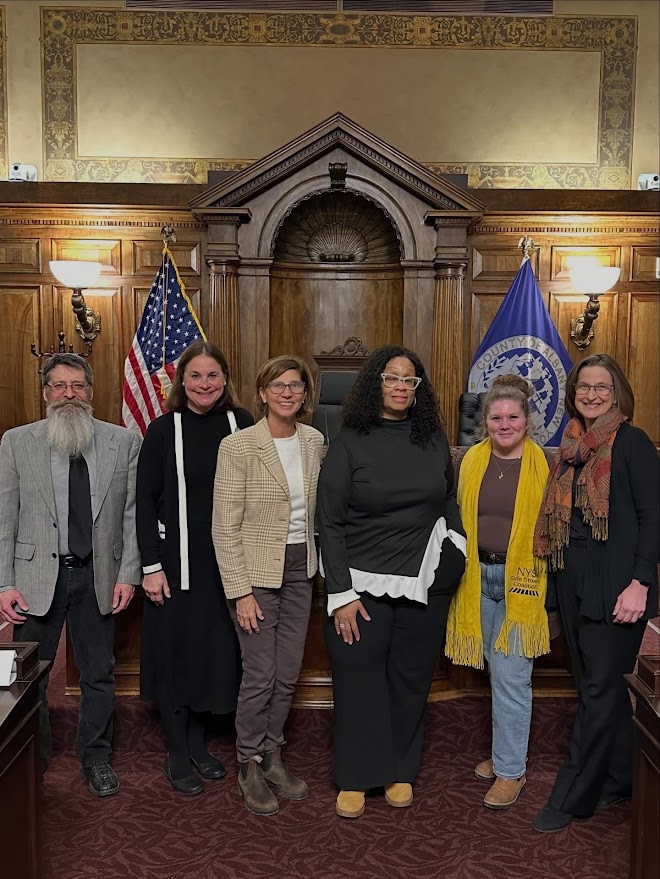
In November of 2024, at our commemoration for the World Day of Remembrance for Victims of Traffic, Albany Bicycle Coalition, Capital Streets and Walkable Albany joined in calling for an Albany County law to require motorists to give bicyclists, pedestrians and other vulnerable road users 3 feet of space when passing. County legislators Susan Laurilliard and Sam Fein joined us at the event which we hold each year to remember County victims of traffic violence. They committed to bringing the 3 foot safe passing bill to the County legislature.
It took 14 months, for the proposal to work its way through committees, amendments and hearings. On February 24th a public hearing was held on the proposal. Ed Brennan, President of Albany Bicycle Coalition, Anne Savage, Executive Director of the New York Bicycling Coalition and Casey Allen, Communications Director of Capital Streets spoke on behalf of the proposal to the legislature. Video of their 3 minute testimonies can be found here. On March 9, 2026 the County Legislature voted 37 to 1 to make this County Law. It will go into effect when it is filed with the Office of the Secretary of State.
It is important to note that the law is meant to be educational. We don’t expect police to be measuring the distance from cars to pedestrians and bicyclists with yardsticks. It is doubtful anyone will be charged unless they actually hit a vulnerable road user. We do want to see signage, as is found in all the state’s surrounding NY, that remind drivers to keep a safe distance from the bodies of vulnerable people that they are blasting by in projectiles that increasingly weigh 2 or more tons.
The long-term goal is for the State of New York to join the 41 other states and the District of Columbia in passing statewide defined safe-passing legislation. The bill has passed the Senate but has repeatedly failed to pass out of the Assembly Transportation Committee. We are hopeful that if enough counties pass laws, the state legislature will need to pass a statewide law for uniformity. Albany County joins Suffolk, Monroe and Ulster County as the 4th NY County with a defined safe passing law. Cortland County has a proposal pending and we hope it will be the 5th County in a few weeks. We encourage our friends in neighboring Schenectady, Rensselaer, Saratoga and Greene Counties to join in this effort.
Full text of the new County Law can be found here.
On Friday, November 14th, local members of the NYS Safe Streets Coalition, Albany Bicycle Coalition, Walkable Albany, Capital Streets, Families for Safe Streets, New York Bicycling Coalition, elected leaders, officials and others gathered in recognition of the victims of traffic violence in Albany County and the World Day of Remembrance for Road Traffic Victims. The event was held in Academy Park across from Albany City Hall.
Speakers included:
Ed Brennan, President Albany Bicycle Coalition
Sandy Misiewicz, Executive Director Capital Region Transportation Council
David Galin, Chief of Staff for Albany Mayor Kathy Sheehan
Patty Sawyer, mother of Roger Sawyer, killed by a speeding driver on Washington Ave Ext
NYS Senator, Pat Fahy
Jake Eisland, Chief of Staff for NYS Assemblymember Gabriella Romero
James Rath, Capital Streets
Jackie Gonzales, Capital Streets and Walkable Albany
Bill Ferris, AARP NY
Albany Mayor-Elect Dorcey Applyrs
Erica Schneider, of Parks and Trails New York
Together we read the names of pedestrians and cyclists who have died in traffic collisions in Albany County since 2020. We are asking our City, Village and Town governments to commit to Vision Zero, the elimination of needless deaths and serious injuries caused by traffic crashes. All people in Albany County have a right to safe transportation.
Traffic violence in Albany County is preventable but has gotten consistently worse.
In 2022 Albany County saw the most traffic crash fatalities and serious injuries since data recording and presentation began in 2014 by the Institute for Traffic Safety and Management. This was surpassed in 2023 and surpassed again in 2024. See https://itmsmr.org
Falling fatalities and serious injuries in the City of Albany and other places that have instituted policies to reduce speeds and make roads safer show that local governments can reduce these tragedies.
The deaths in the last year of Gregory Browne, Charles Allendorph, John Bonds, Felipa Martinez-Garcia, Migdalia Aulet, and too many others were not accidents and were preventable.
Traffic violence is a preventable public health crisis. There are proven strategies, including safer speeds and safer road design that save lives and prevent serious injuries. On World Day of Remembrance for Road Traffic Victims, communities all over the globe organized events to demand change. Helsinki, with the same sorts of arterials and highways that Albany County has and over twice the population, just celebrated a year without a traffic fatality. They achieved this because they made a commitment to Vision Zero and took the actions necessary to save the lives and limbs of their citizens. The Cities, Towns and Villages of Albany County need to make that commitment to the people that live here.
At least 41 states and the District of Columbia require motorists to give bicycle riders at least 3 feet of space when passing. New York is one of only 9 states that still does not define the distance for (safely) passing a bicyclist. At last count, the only other states are Alaska, Idaho, Iowa, Missouri, Montana, New Mexico, Texas, and South Carolina. With recent enactments of 4-foot laws in Massachusetts and Vermont, New York is surrounded by states that that require 3 feet or better for passing.
Last year, the 3-foot bill passed the NY Senate. Local Assembly member Phil Steck has dutifully sponsored this legislation. Year after year this legislation has been held up in the NY Assembly Transportation Committee. Suffolk and Monroe Counties decided to take care of their citizens by passing their own laws. With your help Albany County can now do the same.
Albany County Legislators Fein, A. Joyce, Laurilliard and Miller have cosponsored the proposed Local Law T below. It will go before the Legislature’s Law Committee on January 29, 2025. The proposal follows the Vermont and Massachusetts model of protecting not only bicyclists, but also pedestrians and other vulnerable road users.
A LOCAL LAW OF THE COUNTY OF ALBANY, NEW YORK AMENDING CHAPTER 288 OF THE ALBANY COUNTY CODE, ESTABLISHING A MINIMUM PASSING DISTANCE FOR MOTOR VEHICLES
Introduced: 12/2/24
By Fein, Laurilliard, A. Joyce, and Miller:
A local law amending Chapter 288 of the Albany County Code, entitled Vehicles, to create Article IV of such Chapter, entitled Minimum Passing Distance Requirements for Motor Vehicles, to establish a minimum passing distance for motor vehicles passing bicycles.
BE IT ENACTED by the Albany County Legislature as follows:
Section 1. Article Creation.
Chapter 288, Article IV, Minimum Passing Distance Requirements for Motor Vehicles, is hereby created.
Section 2. §288-26, Title.
This local law shall be known as the “Albany County Safe Passing Law.”
Section 3. § 288-27, Legislative Intent.
The Albany County Legislature recognizes that bicyclists, pedestrians, and other vulnerable road users often need to share roadways with motor vehicles out of necessity.
The Legislature also acknowledges that in these situations, vulnerable road users are susceptible to the actions of motor vehicle operators who can pose a threat to their health and safety if passing too closely.
Therefore, this Legislature finds it necessary to establish a minimum passing distance for motor vehicles approaching or passing vulnerable road users.
Section 4. § 288-28, Vulnerable Road User.
“Vulnerable road user” means any pedestrian; person operating a wheelchair or other personal mobility device regardless of motorization; person operating a bicycle or other non-motorized mode of transportation such as roller skates, rollerblades, roller skis, skateboard, longboard, or unicycle; operator of roadway construction, repair, or maintenance equipment; utility worker; construction worker; roadside assistance worker; operator of agricultural equipment; person riding, driving, or herding an animal; law enforcement officer; firefighter; emergency medical technician; or first responder.
Section 5. § 288-29, Minimum Distance Requirements for Motor Vehicles.
The operator of a motor vehicle that is approaching or passing a vulnerable road user shall do so at a distance of at least three feet until safely clear thereof. The three-foot distance requirement shall not apply on roads with clearly-marked bicycle lanes as defined by New York Vehicle and Traffic Law § 102-a.
Section 5. § 288-30, Penalties.
1. Any person committing the above-referenced offense shall be guilty of a violation and subject to a fine not to exceed $225 for a first offense, $325 for a second offense and $425 for any third or subsequent offense(s).
2. This section does not preclude a person from being charged with, convicted of, or punished for any other violation of law.
Section 6. § 288-31, Applicability.
This local law shall apply to all actions occurring on or after the effective date.
Section 8. § 288-32, Severability.
If any clause, sentence, paragraph, section, subdivision, or other part of this local law or its application shall be adjudged by a court of competent jurisdiction to be invalid or unconstitutional, such order or judgment shall not affect, impair, or invalidate the remainder of the local law which shall remain in full force and effect except as limited by such order or judgment.
Section 9. SEQRA Compliance.
This County Legislature determines that this local law constitutes a “Type II action” pursuant to the provisions of the State Environmental Quality Review Act (SEQRA), and that no further action under SEQRA is required.
Section 10. Effective Date.
This local law shall take effect immediately following its filing with the Office of the Secretary of State.
The Bottom Line – If New Yorkers want safer streets, they are going to have to “stand up and be counted” against those forces that – knowingly or otherwise – stand in the way of this goal.
The Backstory – Once, a long time ago, the statewide municipal speed limit was 25 mph. The highway limit was 50. Somewhere along the way to our present state of roadway mayhem, the municipal limit was raised to 30 and the highway to 55 (1974). Remember? Somehow the “traffic engineers” decided that if we were killing people at 25, why hesitate to go to 30? Aren’t people in a hurry to get somewhere? But wait! “Results show that the average risk of severe injury for a pedestrian struck by a vehicle reaches 10% at an impact speed of 16 mph, 25% at 23 mph, 50% at 31 mph, 75% at 39 mph, and 90% at 46 mph. The average risk of death for a pedestrian reaches 10% at an impact speed of 23 mph, 25% at 32 mph, 50% at 42 mph, 75% at 50 mph, and 90% at 58 mph.” National Association of City Transportation Officials will tell you the same thing. This is the AAA speaking, probably one of the organizations that, of any, backed the “all cars-all the time” situation in which we now suffer. Would you want to guess what the average actual speed is in 30-mph zones?
What We’re Doing – Albany Bicycle Coalition (ABC) is part of the statewide Safe Streets Coalition that pushed for the 25-mph legislation. It passed last year, 2022. ABC worked with the bill sponsors to coordinate the campaign to get passed. It was part of the set of bills called the Crash Victims Rights and Safety Act (CVRSA) that was regularly discussed at ABC meetings. ABC members made calls and wrote to State Legislators and the Governor, participated in a Lobby Day at the Capitol, and spoke before the Assembly Transportation Committee. ABC was successful in getting Albany City Common Council to unanimously pass a resolution in support of the CVRSA. Other cities and towns followed. Three of those CVRSA bills passed including the 25-mph bill.
The 25-mph law was a victory, but it was tempered with a late amendment placing substantial barriers in the way of implementation. This same mentality is also the reason we still don’t have a 3-foot safe passage law for cyclists as is the case in 36 other states and the District of Columbia.
The Cities Speak – After the bill passed Albany, Troy, Schenectady, Bethlehem, and Saratoga Springs all started to pursue lowering their speed limits. We are following their progress and need to be ready to speak out when these ordinances are ready for public comment. In the meantime, there is great confusion about what is required to meet the hurdle of the language below. We hope that the Capital District Transportation Committee (CDTC) will hold a webinar to help everyone contend with it all the barriers to this critical, “safety-first” speed limit.
ABC and other Safe Streets members are concerned about the lack of clarity on how to proceed to 25 mph. We ask – why not base the speed-reduction ordinances on these factors?
Rate of fatalities and injuries.
Existing studies (e.g., the data already in Albany’s Bicycle/Pedestrian Master Plan).
Increasing prevalence and deadliness of larger vehicles.
Increasing statewide traffic violence (e.g., all traffic fatalities in NY up another 4 percent in first 9 months of 2022).
In the meantime, we are waiting for regulations. If they are not satisfactory, we will probably seek a new amendment to the statute.
Act Now – This year ABC is joining with the Safe Streets Coalition in pursuing the bills that can be found at https://www.transalt.org/safe. The collection of bills is called the Safe Streets Act (instead of the Crash Victims Rights and Safety Act). You can help by following the link and then clicking on “Take Action Now for Safe Streets”. It will help you auto-generate a message to your NYS Senator and Assembly Member. You can edit the message to include your comments about the current 25-mph bill!
You can also help make streets safer locally by spreading word about the Capital Region Vision Zero Alliance. This Alliance is taking the effort for safer streets beyond bicycle and pedestrian groups. We aim to diversify, coordinate and amplify the demand for the tried-and-true changes we need on the local level. We want to bring in organizations concerned with public health, crime, safety for our young and old, and even AAA – anyone concerned with safe roads.
Barriers – This is the Infamous language (the complete source appears below) included in the 25-mph law: “No speed limits shall be established pursuant to the provisions of this section except in accordance with the engineering considerations and factors for speed limits set forth in the manual and specifications for a uniform system of traffic control devices maintained by the commissioner of transportation pursuant to section sixteen hundred eighty of this title, as such manual and specifications may be amended from time to time, certified by a licensed professional engineer who specializes in traffic operations.”
This is a gross misunderstanding of the intent of the law and its implementation. The 25-mph law needs to be a political and societal decision based on the safety needs of all road users and not a technical/engineering one based on outmoded priorities and dated expertise. It is absolutely insane that cities cannot determine the best speed limit in certain area. Thirty mph on narrow, one-way streets is too fast as it is on many residential and commercial areas. If imposition of the 25-mph limit is contingent on a traffic study, cities, such as Albany, will delay movement on 25 mph waiting for the study. They have no choice.
But It’s Worse – In spite of NYSDOT abysmal design-for-death practices, it is empowered to interfere in almost any aspect of establishing 25-mph limits. According to the following, the NYS Legislature has again ignored NYSDOT’s past and current road design debacles and has re-empowered it to squelch any but the most strident safety advocates or municipalities. With DOT’s grip on the purse strings and with its power to frustrate almost any road/street project. It seems to hold all the cards in what is really only a baby step toward equitable road design.
Learn More – Here are some links for those who are genuinely interested in roadway safety and who are fed up totally with the “all cars-all the time” philosophy that drivers urban “traffic planning:”
Guidance on Implementation of 25-mph Speed Limits from New York State Department of Transportation – October 19, 2022 – Office of Traffic Safety & Mobility
The fine fall weather provides opportunities for some nice riding whether for recreation/exercise or errands/work. Here are tips to encourage your riding and to keep you safe:
Check your lights front and rear. “Too many lights” are just about right in the low-light, fall and winter conditions. Your lights are primarily to make you visible (both day and night), but also to avoid hidden ruts, potholes, and bumps in the street. Road debris at night is another hazard which good front lighting will help you avoid.
Add a helmet or head-mounted lamp to help see those potholes, debris, etc. at night. While a front light in blink mode makes people more aware of your presence, the headlamp helps you see obstacles. The advantage of a headlamp is that when you move your head, the light goes with you. When on trails with little or no street lighting, both the headlamp and front light (in steady mode) will light the path.
Keep your re-chargeables charged. Replace the batteries in the rest.
Have someone view your bicycle from behind in the dark with the lights “on.” Ensure that your gear or clothing does not block the light beams (front and rear) and that the rear light(s) aim toward following vehicles.
Spoke lights or spoke reflectors are both fun and provide visibility from the side.
Watch other people on bicycles and judge their “visibility index” as a guide to improving your own.
Add an extra “blinky light” front and rear and use them both as nighttime supplements and as “daytime running lights.”
Maybe shop for and use a helmet mounted rear-facing light.
Be fair to people in cars – let them see you. Driving is challenging at this time of year. Don’t join the “ghost bike” program.
You will ride safer and smarter if you are comfortable – so plan your riding gear accordingly. Use the layering technique.
As you bundle up, look at your outer layer. If it is dark in color, either choose something that is not or pick up a reflective vest from your locally owned hardware or big box home center for around $20.00. You might add this vest to your year-around “kit.”
Wet leaves and snow are slippery so anticipate your stops and turns.
Pay special attention to puddles of water or clumps of leaves as they can mask the plentiful potholes, ruts, utility caps, and craters in the paved surface. City streets are worse than ever so watch for crevices, bumps, utility covers, patches, and so on. Good front lighting will help here!
Recall that some pavement markings can also be slippery when wet or extra slippery when covered with wet leaves, snow, or ice.
Keep your chain clean and lubricated (especially after riding in melted slush).
You might want to inspect your tires for wear. You might swap the front to the rear (since the rear takes the most weight and wears more quickly). If planning to ride in snow, you might invest in wider, knobby tires for better traction (if your bike accepts them).
Consider reducing tire pressures from max by 5 to 10 psi for better grip.
Sunglasses are very important this time of year as well. With the days getting shorter, there is a greater chance you will end or start a ride in low-light conditions. Switch your tinted lenses to a rose or clear lens for better visibility in low-light conditions.
When riding into that low fall sun, remember that the people in cars behind may not see you, as they also will be blinded.
Plan your braking and turns to avoid a spill.
Be mindful of slippery metal surfaces (such as utility covers and grates).
Fall and winter is a good time to get ready for next year’s riding with a tune up from one of our local bicycle shops. This is a good time to support your local shop and to help them over the slower winter season. November through March is good time to get that special attention from your bicycle mechanic. Find out where at – https://albanybicyclecoalition.com/resources/




 Albany Bicycle Coalition