The City of Albany is developing an Albany Bicycle/Pedestrian Master Plan to replace the 2009 such plan. The earlier plan limited itself to bicycle issues while the proposed pan also addresses issues facing pedestrians since the vast majority trips by any alternative mode of transportation begins and ends with people walking.
The Albany Bicycle Coalition (ABC) was heavily involved in the development of the 2009 plan and has been fully engaged in monitoring the current effort. While the city has yet to release a draft of the plan, ABC offers recommendations for the plan as enumerated below. An emphasis of our positions is that the proposed Albany Bicycle-Pedestrian Master Plan must embrace all forms of transposition since no one form can be addressed independently from the others – that is, “transportation equity.”
The Albany Bicycle Coalition, Inc. takes the opportunity offered by the development of the City of Albany’s Albany Bicycle-Pedestrian Master Plan to present its transportation ideas for the future of our city. We present our program in two parts as follows:
- Specific, bicycle-related projects that the city needs to begin work on immediately.
- Foundational propositions that cover all aspects of the plan whether it impinges on pedestrians, cyclists, bus riders, or motor vehicle drivers.
Our position is that the City of Albany, like many, many cities, allowed itself to become car centric. All transportation issues center around and are decided upon accommodating more and more motor vehicle traffic or upon sustaining current volumes (“Level of Service”). Accordingly, people – regardless of their specific mode of transposition – are subjected to dangerous street conditions, air and noise pollution, and limitations to their enjoyment of the built environment. Our road and street network is completely “behind the times.” We believe that the Albany Bicycle/Pedestrian Master Plan is really the “Albany Transportation Plan” and, as such, must reach beyond considerations of walking or riding a bicycle to encompass all citizens.
We base many of our propositions on the fundamental belief that our streets, roads, and sidewalks should be safe – not “pretty safe,” or “safer,” but SAFE. There can be no compromise. Sacrificing safety for the convenience of a minority of motor vehicle operators cannot continue.
We believe that the points we set forth in this document can pave the way for bold new thinking. If the City of Albany will embrace a new approach to transportation, it will provide unending benefits to its citizens, will position itself to be competitive in attracting new populations and businesses, and will become a model for other municipalities. The city will be able to cope more effectively with the coming change in the availability of cheap petroleum and increasing pressure to reduce its consumption and replace it with other forms of energy suited to transportation.
Specific, Bicycle-Related Projects
- Western Ave. Bicycle Lanes – Connect Western Ave. from Madison Ave. to the Guilderland portion of Western Ave. to form a seamless, calmed commuter and recreational route. Western Ave. from the University at Albany to Madison Ave. at Allen St. has two schools with posted 20 mph zones and many business and residences with exiting and entering traffic. The extra wide double lanes encourage speeding and erratic lane changes threatening everyone’s safety. This is an ideal street for Traffic Calming. This wide street section with essentially no parking has ample room for buffered bicycle lanes without impeding the smooth flow of motor vehicle traffic.
- Install bicycle lanes on New Scotland Ave. especially between Manning Blvd. and the Thruway Overpass. Bike lanes were strongly preferred over parking for traffic calming on this section of New Scotland by community members participating in the City’s recent Upper New Scotland Traffic Study.
- Install bicycle lanes on Green St. and improve the crossing at Madison Ave. to provide safe downtown bicycle access from South Albany
- Complete bicycle lanes on Shaker Rd./Loudonville Rd. to Broadway
- Complete bike lanes on North Manning Blvd. from Lark St. to Livingston Ave.
- Complete Clinton Ave. bike lanes from Ten Broeck to Broadway where they can connect to the new Albany Skyway and the Empire State Trail/Mohawk-Hudson Bike-Hike Trail.
- Work with Menands to extend Broadway bike lanes to provide safe downtown bicycle access from Menands to North Albany.
- Improve Everett Road I-90 interchange/overpass to make it safe for pedestrians and cyclists who must use this road to cross I-90 and the railroad tracks.
- Provide bike lanes and traffic calming for Washington Ave. west of Brevator
- Change Belgian blocks (“cobblestones”) on Lark St. and South Pearl St. intersections to a traffic calming surface that does not cause bicyclists to fall.
- Coordinate with Colonie and Guilderland to install bike lanes and or multiuse side path along Rapp Road/Lincoln Ave. from the City of Albany’s Rapp Road Waste Management Facility to Village of Colonie’s Cook Park to accommodate cyclists, pedestrians, and hikers using the Pine Bush, Six Mile Waterworks lake, park and trail, and Cook Park trails.
- Coordinate with Delmar and Town of Bethlehem to extend Delaware Ave. bike lanes and traffic calming efforts from the Normans Kill Bridge to McAlpin Ave. Establish safe cycling routes from that point to Hackett Blvd. and Madison Ave.
- Work with the Town of Colonie to develop the Patroon Creek Greenway from Six Mile Waterworks to Tivoli Lake Preserve and the Albany Skyway
- Cross-Town bicycle Expressway – Construct a cross-town connector between Northern Blvd./McCrossin Ave. to Clinton Ave. bicycle lanes and to Whitehall Rd./Delaware Ave.
- Extend Hackett Blvd. multi-use path with bicycle lanes to Manning Blvd.
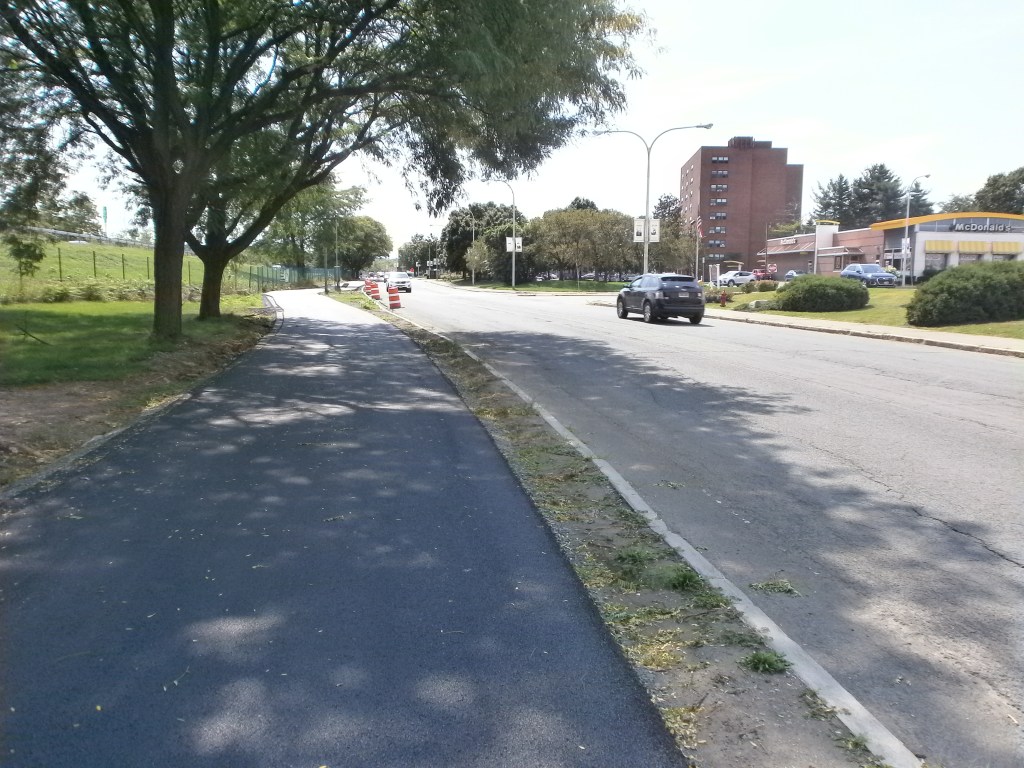
- Improve informal path/trail from Lark St. behind Hackett Middle School to Hackett Blvd. multiuse path at Holland Ave. by the McDonald’s
General Principles for the Albany Bicycle/Pedestrian Master Plan
Safe Street Infrastructure Improvements
- Enhance viewing space for drivers, cyclists, and pedestrians at intersections. “Daylight” all intersections as provided in the city parking code to 20 ft from each crossing street by painting curbs yellow and/or with painted “bump outs.” (§ 323-34 Street crossings kept open for passage – “… extending back into each street 20 feet beyond said corner, shall be kept free from all vehicles … “). Create a clear space at all intersections to improve visibility for bicyclists, pedestrians, and operators of motor vehicles. Do this by removing parking for a yet-to-be-determined distance and then “bumping out” the curbs to shorten crossings and prevent motorists from parking in the clear space areas (similar to the Delaware Ave. reconstruction.) Post signs to restrict the parking at corners until funds are available to reconstruct the curbs.
- Emphasize “safe streets” over “complete streets.” Make safety the priority in all street designs. New York State law defines a Complete Streets as roadways planned and designed to consider the safe, convenient access and mobility of all roadway … including pedestrians, bicyclists, bus riders, and motorists (Complete Streets Act – Chapter 398, Laws of New York, 8/15/11). While the law implies that safety will be a considered, it does not make safety the primary goal. Rather, Complete Streets implies a compromise over all mobility modes without paramount consideration for the vulnerability of certain road users. Since most Albany streets and intersections are or were designed for maximum motor vehicle throughput, it stands that no street redesign project proposal should ever consider the null alternative “do nothing.”
- Prohibit diagonal or perpendicular parking throughout the city except for previously established Albany Police Department facilities. Backing up is inherently dangerous to cyclists (and to motor vehicles).
- Reduce speed limit on all residential streets to 25 mph.
- Reduce to 20 mph the speed limit in a newly established “green zone” bounded by Clinton Ave., Broadway, Madison Ave., and Henry Johnson Blvd.
- Work with New York State legislators to provide home rule for cities to set speed limits below 30 mph (outside of schools zones). For specific projects, apply for “home rule” for traffic safety advancements such as a “20 Is Plenty” “green zone” described above.
- Reduce speed limit on park roads in the City of Albany to 15 mph with traffic calming changes made to roadways to discourage driving over the desired speed. Calming techniques include reducing the width of driving lanes, squaring intersections, installing speed bumps and speed tables, and changing the road surface.
- Close parks to all through traffic driving on Sundays between noon and 5 pm
- Reduce all in-city motor vehicle travel lanes to 11 ft or less except where the passage of emergency vehicles dictates greater width. These narrowed roadways and/or travel lanes will calm traffic thereby improving traffic safety on the roadways. Each street design project will suggest different approaches to this objective. In some case, for example, painting shoulders might suffice. Other cases might call for bicycle lanes, bicycle lane buffers, or curb relocations.
- Post more “No-Turn-on-Red” signs and use illuminated “No-Turn-on-Red” signs that activate at certain periods during the signal cycle or when pedestrian push buttons are active. This will increase pedestrian and bicycle safety. Increase the number of intersection where “no right on red” is the rule especially in areas with high pedestrian and public transport traffic. An example would be for all cross streets on Central Ave.
- Analyze intersection crashes to improve intersection safety and then designate these areas for redesign, education, and enforcement. To not limit this investigation to Albany Police Department traffic incident reporting.
- Provide motorcycle-only parking spaces. Establish these spaces at the beginning or ends of parking areas on each block (angle parking for motorcycles). Determine the number of spaces per block or area by working with motorcycle groups and the Albany Parking Authority. (This will improve intersection sight lines and reduce risk to motorcycles of parking in conventional parking spaces.)
- Review traffic patterns to determine if the city needs to change signs and traffic signals.
- Perform a city-wide traffic sign inventory. Reduce number of signs where possible to increase compliance with the posted regulations or warnings. Analyze the results with the following objectives: reducing sign clutter (to increase the utility/impact/effectiveness of the remaining signs); assessing whether signs installed “years ago” are still needed; and assessing whether or not evolving traffic patterns suggest new, revised, or unneeded signage. Continue to prohibit all signage not directly involved with traffic control and safety. Do in phases to control costs. This would dictate removal of all promotional and commercial signage, with the possible exclusion of some directional signage.
- Develop a master plan for Traffic Engineering. Develop an Engineering approach to calm aggressive driving.
- Analyze on-street parking in the City of Albany with a special emphasis on the following: enhancing viewing space for drivers, cyclists, and pedestrians at intersections, restricting parking at intersections, and striping to preclude driver creation of an informal right-turn lane), and establishing pull off/pull out for buses (i.e., analyze problem “stops” and remove parking as indicated). Gradually reduce the number of on-street parking spaces from designated areas to enhance community growth and street-side ambience.
- Start and continue a share-the-road campaign to make roadways friendlier for all modes of transportation.
- Starting with Albany Police Department traffic/crash data, identify existing danger areas. Analyze the areas for remediation through engineering, education, and enforcement. Consider publishing the results. Consider special signage, lane reconfiguration, road redesign, markings, or speed limits for the identified “danger zones.”
- As a rule, reconfigure all intersections to have 90-degree turns to reduce speeds and enhance safety for pedestrians. This will discourage high-speed turns that can be deadly to pedestrians and cyclists.
Bicyclist Specific Safety Improvements
- Concentrate on establishing a city-wide network of bicycle facilities rather than on isolated segments.
- Restrict installation of shared lanes (“sharrows”) only as provided by National Association of City Transportation Officials in conjunction with bicycle facilities such as bicycle lanes, protected bicycle lanes, and cycle tracks. Although people on bicycles may ride on all non-limited use highways (e.g., interstates), bicycles may at times legally share (or “take”) the traffic lane. Shared lane markings reinforce the legitimacy of bicycle traffic on the street. This is especially true where keeping to the right is unsafe. They serve as a reminder to people in cars that bicycle riders may be present and that they have “taken the lane” for their own safety.
- Improve on the League of American Bicyclists’s Bicycle Friendly Community designation.Analyze the suggestions provided by the League of American Bicyclists in its review of City of Albany’s bicycle friendly community designation.
- Selectively establish bike-only and or separated bikeways to promote more biking.
- Promote work-place bicycle lockup areas for those who ride to work.
- Install and build more bicycle accommodations throughout the City including bicycle racks, fix-it stations, lanes, and intersection “bike boxes.”
- Install signal detectors capable of identifying bicycles. Mark areas at selected intersections to inform bicyclists where they should be on the pavement to activate the traffic signal at intersections that have actuated approaches.
Pedestrian Specific Safety Improvements
- Re-program all on-demand pedestrian crossing lights to a “pedestrian priority” sequence wherein pressing a demand button will provide for crossing immediately after the end of the current motor vehicle phase in the complete cycle. Allow pedestrians to enter their demand even when the street to be crossed is currently red to stop motor vehicle traffic after the next motor vehicle cycle.
- At selected signalized intersections, implement an advanced pedestrian interval or exclusive pedestrian phase in the signal operations to improve pedestrian safety. Examples for this treatment include Lark St./Madison Ave. Delaware Ave., Washington Ave. /Lark St., Delaware Ave./Holland Ave./Morton Ave., and Allen St./Madison Ave./Western Ave.
- At select signalized intersections, increase yellow clearance times and all red times to increase intersection safety during high pedestrian use hours.
- At selected signalized, high-pedestrian-use intersections, employ ALL WAY STOP signalization. Do this in such a way as to not increase or encourage “pause” by people in cars who do not want to continuously stop at intersections.
- For pedestrian heavy streets, install midblock crossing locations preferably with raised, sidewalk-high “green zones.” Where appropriate, signalize these midblock crossings (e.g., Central Ave., Washington Ave.)
- Install sidewalks on all roadways to encourage walking and improve safety on roadways. This is especially relevant where pedestrians currently have to share the travel lanes with motorists and bicyclists.
- Where sidewalks do not exist, install warming signs for motorists and, where appropriate, “walk left” signs for people walking.
Bus/Bus Rider Safety
- Establish ADA compliant bus stops in logical locations with bump outs to provide areas where buses can discharge or pick up passengers on the sidewalk and not in the travel, bicycle, or parking lanes.
- Coordinate with Capital District Transportation Authority in analyzing “problem” bus stops using CDTA and city data and driver testimony.
- Determine what actions the city might take to ease reentry of buses into the traffic lane.
- Provide more bus operator traffic signal control.
- Wherever possible, implement bus-only travel lanes.
- Work with City School District on an engineering approach to school bus safety. This includes safe pickup and drop off locations that still meet all guidelines and laws. Implement School Zone Safety program. Provide bus, parent drop off/pick up areas at each school large enough to accommodate each. This will improve transportation on roadways around the schools. Work with the School District through the education and enforcement groups to ensure the engineering plans are followed. Encourage the School District to embrace traffic safety that goes hand in hand with school safety. Coordinate with the School District on analyzing trouble spots at the exits/entrances of identified schools. Once completed, use this as a model for the public-charter and private schools (perhaps asking them to do a self-analysis)
Other
- Priority sequence all of the Albany Bicycle/Pedestrian Master Plan’s major projects.
- Provide a specific time line for each major planned project in the Albany Bicycle-Pedestrian Master Plan with a completion-by-date specified.
- Improved coordination with neighboring municipalities to provide a regional bike transportation network. Pay particular attention to the interface points between municipalities (e.g., Everett Rd. at I-90, Delaware Ave. at the Normanskill, and Western Ave. at the city line with Guilderland).
- Divest all City of Albany Parking Authority Parking lots/garages and sell to private business. This will increase the cost of “downtown” parking and provide the city with tax revenues.
- Encourage use of park-and-ride. Analyze traffic and public transport data to assess the benefits of having more park-and-rides. Identify businesses/agencies that should be encouraged to support park-and-ride.
++++++
“Cities have the capability of providing something for everybody, only because, and only when, they are created by everybody.”
[SOURCE: Jane Jacobs, “The Death and Life of Great American Cities”]

++++++






 Albany Bicycle Coalition