



“Social Distance” Family Ride




First Responders (?)
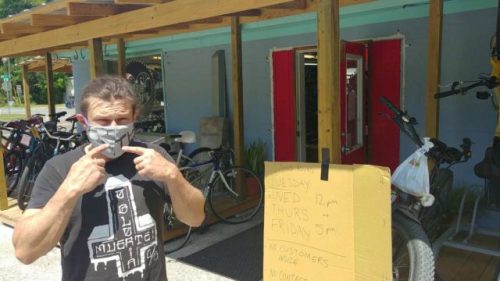



“Now go wash your hands (20 secs).”
####
First Responders (?)
####
Filed under Activisim, Comings and Goings, COVID-19
Your bicycle’s chain is second in importance only to your brakes. So what is the feature of a bicycle chain that allows it to remain serviceable for many thousands of miles? What’s the secret ingredient?
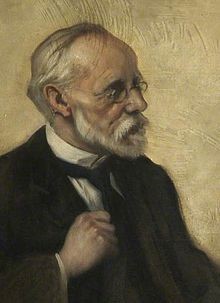
Bicycle chains are properly “bush roller chains.” Hans Renold invented this common bike chain and patented it in Manchester in 1880. This Swiss engineer was born in Aarau, Switzerland (about 30 miles west of Zurich). In 1873 at age 21, Renold found work with a Manchester machinery-exporting firm. In 1879, he purchased a textile-chain business in Salford near Manchester and, a year later, gave us the gift of the Bush Roller Chain.
In Coventry, about 100 miles south of Manchester, J.K. Starley invented the “safety bicycle” also in 1879. This first replaced the “high wheel” Penny-farthing but with a drive chain unfit for its purpose. The chains were noisy and wore rapidly. The “safety” 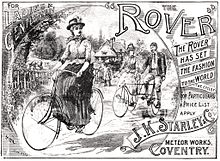 used the basic diamond shape configuration that survives to the present. This breakthrough in cycling allowed riders to sit lower on the frame and to have greater control of speed, more maneuverability, and ease of stopping.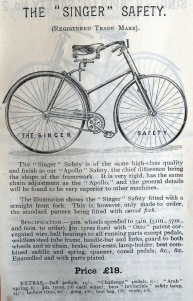
The Problem – If a chain drive application is in a clean environment, the wearing surfaces are safe from dust, precipitation, mud, and airborne grit. However, as you may have learned from “hands-on” experience, there is nothing on earth dirtier that a bicycle chain. These exposed chains have high rates of wear. This is particularly so when cyclists are prepared to accept more friction, less efficiency, more noise, and more frequent replacement as they neglect lubrication and adjustment. As the chain grinds away on the accumulated grime, it produces a microscopic covering that continues to act like pumice on sprocket teeth and chain links. Thus, your bicycle chain does not really stretch – it just gets longer as the pins and rollers wear.
The Solution –


So what did Renold invent? In his US Patent application he states (as he may well have in his earlier British Patent No. 26805 of 1910): “This invention relates to chains of the silent type, wherein segmental liners are employed engaging in the links and bearing upon the studs, as described for example in the specification of British Patent No. 26805 of 1910. It is the object of the present invention to improve chains of this type by modifications in the construction thereof designed primarily to facilitate lubrication and so greatly to prolong the life of the chains.”

Layout of a roller chain: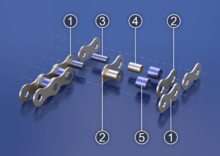
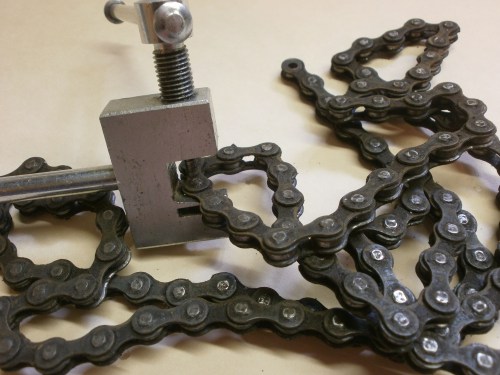
A Closer Look – So let us dive into a chain and see for ourselves. The layout of a roller chain consists of two outer plates held together by pins. (These immobile pins are what you partially remove to “break” [or open] a chain. Modern chains are opened at a master
Dirty Chain
link without need of a traditional chain tool.) Within the outer plates is inner plate “sandwich” consisting of bushings staked into the two inner plates and upon each of which rides a freely moving roller – this is Renold refinement.


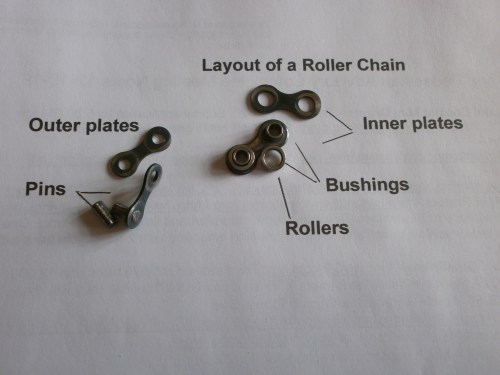
You can disassemble a chain further to see for yourself, but the chain link will then be usable. Alternatively, if you look carefully at a slack portion of your chain, you can spin the roller on its bushing with a small pointed instrument (such as a screwdriver). You will not be able to see the bushings as the outer plates, the pins, and the rollers hide them. At this point, you may well appreciate the importance of regular chain lubrication and occasional cleaning. What Renold did was replace sliding friction of pin-and-link chains with their immovable pins rubbing against sprocket teeth by designing a rolling motion thereby reducing noise and wear. While we may now take this simple insight for granted, it ensures that our bicycle chain will perform flawlessly for many miles. Notably, even with patent protection, Renold allowed cycling firms to use his roller chain in their own products without paying royalties.
Ian, a commenter on this post, reported that “One of the interesting facts is in the year 1906 when the helical roller chain was patented, some chain companies would have you believe they invented it in the 1990s and call it ‘low noise chain’.” (9-28-20)
Related How-to Videos –
A Little History – But what happened to Hans Renold’s firm? His great advance in chain design provided the foundation for modern precision roller chains. Renold was a brilliant engineer and a model employer who built a very skilled labor force. He was also an astute businessman. His business prospered, and he steadily ploughed profits back into it. In 1889, rapid business expansion called for a new factory, Progress Works, which the firm built on Brook St. In 1906, Hans Renold planned and started construction of Renold Works on open land at Burnage, five miles south of Manchester. Renold was devoted to establishing a sense of community among his employees and their families, and, in 1909, gave his active support to the establishment of the Hans Renold Social Union for the encouragement of a wide range of leisure activities. After his death in 1943, Priestnall Hey, his home adjacent to Renold Works at Burnage, went for use by the Social Union. Hans Renold Limited formed as a private limited company in 1903. It merged with The Coventry Chain Company Limited and registered as a public limited company named Renold and Coventry Chain Company Limited in 1930. It was renamed Renold Ltd. in 1967, and later became Renold PLC. The company still bears his name. Today, Renold employs around 2,500 people in more than 23 countries around the world.
So as you cruise silently down the road or trail with a clean and well-lubricated chain, be thankful to the Swiss for their gift to your cycling enjoyment.

USA Bikes + Swiss Brains
TIMELINE –
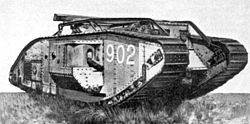 Patented the segmental bush design of inverted tooth (silent) chain. Around 1916, The Coventry Chain Company Ltd. developed and manufactured track chains for use on tank vehicles. (From late 1914, a small number of middle-ranking British Army officers tried to persuade the War Office and the Government to consider the creation of armored vehicles. Amongst their suggestions was the use of caterpillar tractors, but although the Army used many such vehicles for towing heavy guns, it could not be persuaded that they could be adapted as armored vehicles. The consequence was that the Royal Navy carried out early tank development in Great Britain.)
SOURCES:
+++++++
Filed under Article, Bike Tech, Product Review
Here is what happens when people who never walk and never ride set out to design bicycle lanes.
One would think the first photo one has something to do with a pedestrian crosswalk, but no ….

The second photo shows (1) that the bicycle lanes are ON THE SIDEWALK, (2) that there are people walking on the sidewalk, and (3) that, later on, the city of Annapolis put its BikeShare “hub” in the sidewalk area and on its misguided bicycle lane.
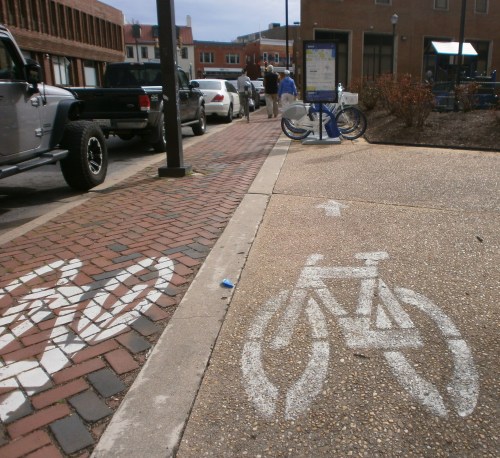
This scene is from Annapolis MD – a flat, bike-able, and walkable city but one that is totally tuned to an “all cars-all the time” philosophy.
Filed under Bike Lanes, City Review
Unless you are a dedicated year-round cyclist, the condition of your bicycle(s) may be far from your mind. Right now might be the best time to think about how soon spring will arrive and how great it will be to get out for a ride – provided your bicycle is ready to go.

There are, of course two ways to go – a professional tune up at a local bicycle shop or a do-it-yourself job.
YOUR LOCAL BIKE SHOP – Getting a complete tune up from your bicycle shop makes the bike ride like new again. Even nuisance noises that do not affect the bike mechanically are gone and you can ride carefree. Things you might miss – one brake shoe toed out, a barely noticeable wheel wobble – will not escape the notice of good technicians. They will look over your entire bicycle in the course of doing a pre-season “tune up.”

Remember that internet retailers will not be there for you when you need advice, repairs, a part in a hurry, or a tune up – your local bicycle shop will be. You may save a bit of change (even after shipping and the hassle of possible returns) and get “next day delivery” (who REALLY needs that?), but you’ll miss all the benefits of a good relationship with your shop’s personnel.

Here is a list of area shops – see the Albany Bicycle Coalition website for updates. https://albanybicyclecoalition.com/resources/local-bike-shops/
DO IT YOURSELF – If you prefer to do your own work, there are plenty of “how-to” videos – a good place to start is with Park Tool’s at https://www.youtube.com/user/parktoolcompany Just as an example that anyone can use – how to fix a flat. https://www.youtube.com/watch?v=58STtUM-Wow&list=PLGCTGpvdT04SCKR3pm1OsC5mUF9dapUuz

Speaking of tools, you’ll want to buy the best you can find. For bicycle-specific items, again, Park Tool is a good place to start. Many shops have a display rack of commonly needed tools – by Park and others. For general-purpose tools, Sears Craftsman brand tools are now available at some hardware and home stores. With these or Snap-On, you can’t go wrong.


You can use your multitool for many maintenance and adjustment steps but you’ll be happier and do a better job with regular tools. Save the multitool for on-the-road attention.
 Another resource for “do it yourself” is “open bike night” at your local community bike rescue. Here you’ll find camaraderie with like-minded cyclists and advice if you get stuck. You might even want to show off your newfound bicycle servicing skills by volunteering at the bike rescue – there’s no better way to learn than to teach someone else.
Bike Rescues – Here is a list of area bike rescues – see the Albany Bicycle Coalition website for updates. Go here – https://albanybicyclecoalition.com/resources/albanybikerescue/


Filed under bicycle shops, Bike rescue, Bike Tech, Shop Local
Many in the City of Albany- utilitarian cyclists – ride their bicycles because that is their primary means of transportation. We know that there are “a lot” of these bicycle riders who apparently are not engaged in the discussion on bicycle facilities and bicycle safety issues. They do not appear to join with or participate in the activities of “bicycle advocacy groups.” They do not appear at public meetings and presentations on proposed roadway modifications that may affect them.
The question is: How can we engage with these “riders of necessity” – Utilitarian cyclists – so that their concerns can be brought to the table?
#####
The pictures that follow are from ABC’s collection of people on bicycles” and are not intended to identify or categorize any person or rider but merely to illustrate an issue for outreach and investigation.
#####


Filed under Activisim, City Review, Riding to Get Somewhere, utilitarian cyclists