Category Archives: Activisim

World Day of Remembrance for Road Traffic Victims

Introduction – On Friday November 17, 2023,the Albany Bicycle Coalition, Walkable Albany, and Capital Streets, held a demonstration for Albany City Victims of Traffic Violence as part of the World Day of Remembrance for Road Traffic Victims. Elected leaders and city officials gathered with us along with people around the world to remember those needlessly killed and seriously injured in crashes. We called for specific actions by the City of Albany to respond to the needless deaths of at least 19 people on bicycles or walking in the city between 2013 and 2023. 

Presentation – We thanked the following for joining us in support of the event: NY Assembly Member Pat Fahy, Albany Police Department Chief Eric Hawkins, Mayor Sheehan’s Chief of Staff, David Galin, Albany City Treasurer Darius Shahinfar, and Albany County Legislator Susan Quine-Laurilliard.

Prepared Remarks by Ed Brennan, ABC President – In a few minutes, those who have gathered here will read the names of pedestrians and cyclists who died from traffic violence in our city.  Sometimes we may know a pedestrian or cyclist died from a crash at a location, but we don’t know their names. I suspect some of these people may have hung on for a while in a hospital before they passed. They may have outlasted the news cycle, so their names were never reported.  All we have – without FOILing their records – is statistical information such as that found in the Federal Fatality Analysis Reporting System and in local media. Try to remember that these were actual people – with families that lost them – and not just statistics. We have seen at least 49 traffic violence deaths on Central Avenue since the start of 2001, including David Herskind just 6 days ago.

Sa’Nya Blaylock, died on Central Avenue, Thursday April 15, 2021, around 10:30pm. She was an Albany resident and Albany High student, Unlike the other victims, we recognize Sa’Nya wasn’t killed in Albany, but she was killed on Central Avenue – the deadliest stretch of road in the Capital Region.  A road that Albany shares with the Town of Colonie.

Sa’Nya had gotten off her late shift at Kentucky Fried Chicken, crossed Central Avenue to catch her bus, and was struck and killed by a motor vehicle. 

  • Maybe she was tired after a long day at school and night’s work at KFC.
  • Maybe she was in a hurry to get home and do homework.
  • Maybe she was in a hurry to get off work and get back to being a teenager.
  • Maybe she thought the vehicle coming was her bus and she didn’t want to miss it.
  • We don’t know if she made a mistake in the way she crossed the street or not, but if she made a mistake, she didn’t deserve a death sentence.

Central Avenue was the subject of an extensive 18-month road corridor safety study published in 2015 that came back with what they call a “Three E’s” Approach: Education, Enforcement and Engineering

“Safety is our top priority there, and we’ve done a lot of work and studying on Central Avenue,” said the state DOT spokesperson. “The department’s goal,” he said, “is for both drivers and pedestrians to understand the rules of the road.”

New York State Department of Transportation did a number of things, including $2M in improvements such as better crossing signals – but they would not lower the speed limit or change the road in any way to encourage drivers to slow down.

Since the beginning of 2016 we figure another 19 people have died on Central Avenue.

Looking at state statistics and comparing 2019 before COVID with 2022 in Albany, Schenectady, Rensselaer, and Saratoga Counties, we have seen fewer collisions in each county – but more fatalities with those fewer collisions and more serious injuries with those fewer collisions.

How does that happen?

There are two primary factors that determine how violent a crash is – mass and velocity. Since 2019, both these factors have gone in the wrong direction.

We all know that speeding has increased.

Every year our vehicles have also gotten bigger. Earlier this year the three highest selling new motor vehicles were the Ford F-Series Truck, the Chevy Silverado, and the Dodge Ram. Massive vehicles that will do more damage in a collision.

Our newer, more massive trucks and SUVs are also built higher so they are more dangerous – especially to pedestrians.  What used to be a lower body injury, like a broken leg or pelvis, is now an upper body injury to one’s organs or for shorter people, like children, there are often more devastating head injuries.

The city cannot do much about the size of vehicles, but the city can lower speeds to make collisions less devastating and less likely.

We see laudable efforts to get alcohol- and drug-impaired drivers off the road. But we need to understand that speeders are also impaired drivers. 

  1. The speeder impairs their ability to stop their vehicle within the distance necessary to avoid a collision.
  2. The speeder impairs their ability to react to a potential collision by giving themselves less time.
  3. The speeder also impairs their ability to recognize a potential collision. There are limits to how much visual information we can process in a given space of time. The faster the speed, the more to process and the narrower speeder’s effective field of vision becomes. This problem is worse in dense urban environments where there is so much more to watch out for. 

As we remember these people that have died and suffered serious injuries from traffic violence, we ask that the city honor them by doing three things that make it less likely that more people and their families face such loss and suffering.

  1. Lower the city speed limit on all non-limited access roads to 25 miles per hour to make crashes less likely and less devastating.
  2. Install speed cameras in our school zones to protect our young people using the law that our State Assembly Member Pat Fahy and State Senator Neil Breslin fought to pass. 
  3. Carry out the recommendations of the Washington Park Study. Make this Historic City Jewel a park for the safe enjoyment of the people of Albany and not a high-speed parkway for cars.

Ten Years of Traffic Victims in Albany (2013 – 2023 as of November 14, 2023) – The Albany Bicycle Coalition developed this list based on local media reports, Federal Fatality Analysis Reporting System, and other sources. At this point in the demonstration, 19 volunteers stepped up one at a time to the microphone and read the essentials of each victim’s demise.

  1. Unidentified Pedestrian – 11/8/23 (age 67) Two cars hit and killed the victim near Exit 2 on southbound I-787 in Albany. The man was struck by one car as the vehicle tried to merge into traffic at 7:16 PM. State Police said the driver was initially unaware the vehicle had hit someone. The man was then struck by a second vehicle and died at the scene.
  2. Larry Cunningham – 10/24/22 (age 62) A drunken car driver struck and killed pedestrian on a sidewalk near the intersection of 3rd Ave. and Elizabeth St. Albany. Driver Jose Guevara-Bonilla, a 26-year-old city man was charged with aggravated drunken driving and leaving the scene of an accident and other offences. Police issued several tickets and said more charges are possible.
  3. Pernell Compston – 10/6/22 (no age) Compston was hit by a SUV and a pickup truck just after 10 pm when he was crossing the street near the intersection of Northern Blvd. and Shaker Rd., Albany.
  4. Tanisha Brathwaite – 7/14/22 (age 31) Drunk driver killed pedestrian. Hit-and-run driver struck and killed pedestrian at 6:00 PM on Clinton Ave. at the intersection with Henry Johnson Blvd., Albany. Driver sentenced to 8 to 24 years for aggravated vehicular homicide and several DWI counts.
  5. Kathleen McBride – 7/7/22 (age 52) Van struck and killed a pedestrian on Central Ave.
  6. Unidentified Pedestrian – 5/21 (no age) Per the New York State Traffic Safety Statistical Repository, there was a pedestrian death in Albany during this month. Could not find report in the local newspaper.
  7. Unidentified Pedestrian – 3/21 (no age) Per the New York State Traffic Safety Statistical Repository, there was a pedestrian death in Albany during this month. Could not find local newspaper report.
  8. Unidentified Pedestrian – 9/24/20 (no age) A pedestrian was killed in a collision between 7 and 8 PM on Church St. Albany. This was not at an intersection, there was no drunk driving involved, and the weather was clear but dark.
  9. Richard Harmon – 5/21/20 (age 76) Pedestrian hit and killed at North Allen St. and Manning Blvd. [Times Union, Saturday, 5/23/20, pg. D3]
  10. Unidentified Pedestrian – 9/24/19 (age 50) A car driver going west on Washington Ave. Extension hit and killed a male pedestrian who apparently tried to cross the street in the evening. [Times Union, 9/26/19, Section: Obituaries, pg. C5]
  11. Unidentified Pedestrian – 8/8/19 (age 67) Truck hit and seriously injured a male pedestrian, intersection of Madison Ave. and Dove St. around 1 PM. After being treated at the scene, the man was taken to Albany Medical Center Hospital by ambulance. His condition was not immediately available. [Times Union Friday, 8/9/19, pg. C4. Apparently this individual later died as the Federal Fatality Analysis Reporting System (FARS) lists this a pedestrian death.]
  12. Ludmilla Vink – 2/20/18 (age 92) Pedestrian, was identified as the victim in the fatal car-pedestrian crash on Washington Ave., Albany. [Times Union Thursday, February 22, 2018, pg. C2]
  13. Roger L. Sawyer – 10/19/17 (age 30) Bicyclist run down and killed by a SUV, Washington Ave. Ext., Albany.
  14. Edston J. Kirnon – 7/22/17 (age 42) Bicyclist collided with side of CDTA bus, N. Pearl St., Albany.
  15. Rajine Martinez 2/4/17 (age 21) Killed by hit-and-run SUV driver, Washington Park Rd. near New Scotland Ave., Albany
  16. Gregory Abram-Skinner – 12/23/16 (age 21) At 7:00-8:00 PM on Washington Ave. Ext. at Springsteen Ave., Albany, a drunk driver struck and killed the pedestrian.
  17. Ashiqur Rahman – 12/2015 (age 4) The driver of a refuse truck struck and killed the victim at 8:00-9:00 AM on Central Ave. at Quail St., Albany as he was crossing in the crosswalk, holding his mother’s hand, and walking with the pedestrian “walk” light.
  18. Qazir Sutherland – 6/15/13 (age 7) The car diver, 37, of Albany, was traveling north in her sedan on S. Pearl, Albany when she struck and killed the victim as he was crossing the street to meet his mother. The driver was not charged.
  19. Katherine Parker – 2/21/13 (age 28) At 10:22 PM a minivan driver heading west struck and killed the victim on Central Ave. at King Ave., Albany. The victim was walking north to cross Central Ave.

Media Presence – The Albany Bicycle Coalition was grateful for coverage of the event by the following media outlets:

Times Union

WTEN Albany

WNYT Albany

WRGB Albany

Leave a comment

Filed under 25 MPH, Activisim, Central Ave., City Review, NYS DOT, safety, Support the Cause

World Day of Remembrance for Road Traffic Victims

We ask that all friends of safer streets sign the following online petition to tell the Governor that you want her to sign Assemblymember Fahy’s Complete Streets Funding Bill:  https://p2a.co/rkhfcrb.

<<<<<<<<<<<<<<<<  Press Release >>>>>>>>>>>>>>

For Immediate Release

November 18, 2022

Contact

Ed Brennan

President Albany Bicycle Coalition

518-416-5692

edpbrennan@yahoo.com

November 18, 2022. Academy Park, Albany, NY.  Today, local members of the NYS Safe Streets Coalition, The Albany Bicycle Coalition, Walkable Albany, Parks & Trails New York, New York Assemblymember Patricia Fahy, family members of traffic violence victims and others gathered in recognition of the victims of traffic violence in the City of Albany and the World Day of Remembrance for Road Traffic Victims.  

We read the names of pedestrians and cyclists who died in traffic collisions in Albany since 2017.  We asked that Albany and New York State take the steps necessary to prevent needless deaths and serious injuries caused by traffic crashes in our City.  All the citizens of Albany have a right to safe mobility.  

We need action now because traffic violence is getting worse and hitting home.

  • Nationally, in the past two years, almost 20 percent more people died in traffic crashes, according to National Safety Council (NSC) estimates. That’s 42 thousand people. And the number is rising. 
  • An estimated 7% more people have been killed in the first quarter of 2022, compared to the same quarter last year. This may be the highest number of first quarter fatalities in twenty years.
  • So far in 2022, Albany has seen the senseless loss of Tanisha Brathwaite, Kathleen McBride and Larry Cunningham to traffic violence.  

“New Yorkers are at serious risk of injury or death due to rising traffic violence – according to the Governors Highway Safety Association, crashes killing pedestrians increased 46% from 2010 to 2020, compared to just a 5% increase for all other crash fatalities,” said Assemblymember Pat Fahy (D-Albany). “By developing our communities into more walkable, multi-modal transportation-friendly places to be – we’re saving lives and reducing traffic violence by keeping pedestrians, motorists, and cyclists safe on our streets. Specifically, legislation I sponsor that was passed by the state legislature this year to expand the use of complete street design in transportation projects is important to building a more walkable and multi-modal New York and reducing traffic violence. I thank the Albany Bicycle Coalition and Safe Streets Coalition for continuing to bring attention to traffic violence in our communities and advocate for a state where all of us can feel and be safe on our roads.”

We ask that all friends of safer streets sign the following online petition to tell the Governor that you want her to sign Assemblymember Fahy’s Complete Streets Funding Bill:  https://p2a.co/rkhfcrb.

Traffic violence is a preventable public health crisis. There are proven steps that can be taken to save lives and prevent serious injuries.  On World Day of Remembrance for Road Traffic Victims, communities all over the globe are organizing events to demand change.  This Day of Remembrance was brought to the U.S. by the Families for Safe Streets, a national organization that was founded by the families of loved ones who were killed or injured in crashes in New York. These are the demands we presented to Mayor Sheehan and the Albany City Council to make our roads safer for all that use them:

  • Reducing the Citywide Speed Limit to 25 MPH.   This will prevent collisions and make them less serious.  The slower the speed limit the greater the field of vision for drivers and the less devastating the result of any impact.  Only 1 in 10 pedestrians will survive a collision at 40 mph.   At the current City speed limit of 30 mph 5 out of 10 survive.  At 20 mph 9 out of 10 survive.
  • Making Safety Analysis and Improvement Part of Regular Road Maintenance.  Many road departments have a tendency to just repave and repaint streets exactly as they were.  This has the effect of preserving existing dangers instead of fixing safety problems when it is most cost effective.
  • Narrowing Crossing Distances and Daylighting Intersections.  State law prohibits parking or standing within 20 feet of a crosswalk or 30 feet of a stop or yield sign, however these laws are routinely ignored.   Albany can make intersections safer by actively preventing such parking through deployment of paint, bollards, bike racks, curb extensions and eco-friendly rain gardens.  These methods also narrow intersections allowing vulnerable road users to cross roads with less exposure to traffic.
  • Deploying Speed Humps.  The City should expand its test deployment of speed humps to other parts of the City that are troubled by dangerous speeders.
  • Improving Sidewalks and Crosswalks.  The City has too many areas where crosswalks and sidewalks are in a state of neglect or non-existent.  
  • Deploying Pedestrian Priority Traffic Signals.  Our busy pedestrian intersections should have a “leading pedestrian interval” when all traffic has a red light to enhance the visibility of pedestrians in the intersection and to reinforce their right-of-way over turning vehicles
  • Improving Bicycle Infrastructure.  Albany needs to do more to separate bicyclists from motor traffic.  The City’s major roads should have separate bicycle lanes and preferably protected bicycle lanes.
  • Albany Must Have a Plan for Implementation of its Bicycle and Pedestrian Master Plan.  The Master Plan did a great job of identifying needs and solutions for the City’s lackluster bicycle and pedestrian infrastructure.  The City needs a plan of action and budget to address the needs identified.  
  • Deploying Speed Cameras.  Speeding has become increasingly problematic since COVID.  We have been told our police department is short staffed and has a limited capacity to attend to traffic enforcement.  Speed cameras need to be deployed to identify those deadly speeders that our police cannot.
  • Back in Angle Parking.  Reverse angle parking provides safer roadways since drivers are able to see other vehicles and cyclists easier (and much sooner) when exiting out of their parking spots as compared to standard angle parking.

On the state level we asked for the following:

  • The Governor’s signature on the Complete Streets funding bill passed by the NY Assembly and Senate and sponsored by our own Assemblymember Patricia Fahy.
  • Passage of the Complete Streets Maintenance Bill so that funding is permitted for cost effective safety improvements during repaving and other maintenance projects.
  • Passage of the Crash Victims Bill of Rights to guarantee crash victims and their families rights to incident reports and a voice in legal proceedings.
  • Passage of the Safe Passage Bill requiring drivers to provide a minimum of three feet when passing cyclists.
  • Passage of an Upstate Speed Camera Bill allowing municipalities outside of New York City to opt for speed cameras to identify deadly speeders.

We recognize that the City of Albany and New York State have taken some steps to improve safety and we appreciate those champions of safe streets that are among our elected and public officials.  However, the endless and increasing toll of needless deaths and injuries from traffic violence demands that the above steps be taken, that efforts be redoubled and that greater resources be applied to to prevent these tragedies.

****************************************

On Friday, 11/18/22,we will gather to honor the World Day of Remembrance for Road Traffic Victims (which falls on Sunday, 11/20). The Albany Bicycle Coalition, Walkable Albany, Parks and Trails New York, and others will gather at noon in Academy Park at Eagle and Washington Avenues, across Eagle from Albany City Hall, and across Washington Ave from East Capitol Park and the NYS Capitol. We will recognize the victims of traffic violence in the City of Albany and the World Day of Remembrance for Road Traffic Victims. We will read the names of pedestrians and cyclists who have died in traffic collisions in Albany since 2017. We will ask that Albany take the steps necessary to prevent needless deaths and serious injuries caused by traffic crashes in our city.

We ask that the City adopt a Vision Zero Strategy to eliminate all traffic fatalities and severe injuries, while increasing safe, healthy, equitable mobility for all.  To be effective this Vision Zero Strategy needs to include a regularly updated action plan with action items that are addressed as a normal part of budgeted road and sidewalk work.  The City of Hoboken, NJ adopted such a strategy and has not had a traffic death since 2018.  Following the example of Hoboken and other cities, these are practical and often inexpensive steps Albany needs to adopt for safe mobility:

  • Reducing the Citywide Speed Limit to 25 MPH (Hoboken lowered theirs to 20 mph).   This will prevent collisions and make them less serious.  The slower the speed limit the greater the field of vision for drivers and the less devastating the result of any impact.  Only 1 in 10 pedestrians will survive a collision at 40 mph.   At the current City speed limit of 30 mph 5 out of 10 survive.  At 20 mph 9 out of 10 survive.
  • Making Safety Analysis and Improvement Part of Regular Road Maintenance.  Many road departments have a tendency to just repave and repaint streets exactly as they were.  This has the effect of preserving existing dangers instead of fixing safety problems when it is most cost effective.
  • Narrowing Crossing Distances and Daylighting Intersections.  State law prohibits parking or standing within 20 feet of a crosswalk or 30 feet of a stop or yield sign, however these laws are routinely ignored.   Like Hoboken, Albany can make intersections safer by actively preventing such parking through deployment of paint, bollards, bike racks, curb extensions and eco-friendly rain gardens.  These methods also narrow intersections allowing vulnerable road users to cross roads with less exposure to traffic.
  • Deploying Speed Humps.  The City should expand its test deployment of speed humps to other parts of the City that are troubled by dangerous speeders.
  • Improving Sidewalks and Crosswalks.  The City has too many areas where crosswalks and sidewalks are in disrepair or non-existent.  
  • Deploying Pedestrian Priority Traffic Signals.  Our busy pedestrian intersections should have a “leading pedestrian interval” when all traffic has a red light to enhance the visibility of pedestrians in the intersection and to reinforce their right-of-way over turning vehicles
  • Improving Bicycle Infrastructure.  Albany needs to do more to separate bicyclists from motor traffic.  The City’s major roads should have separate bicycle lanes and preferably protected bicycle lanes.
  • Albany Must Have a Plan for Implementation of its Bicycle and Pedestrian Master Plan.  The Master Plan did a great job of identifying needs and solutions for the City’s lackluster bicycle and pedestrian infrastructure.  The City needs a plan of action and budget to address the needs identified.  
  • Deploying Speed Cameras.  Speeding has become increasingly problematic since COVID.  We have been told our police department is also short staffed and has a limited capacity to attend to traffic enforcement.  Speed cameras need to be deployed to identify those deadly speeders that our police cannot.
  • Back in Angle Parking.  Reverse angle parking provides safer roadways since drivers are able to see other vehicles and cyclists easier (and much sooner) when exiting out of their parking spots as compared to standard angle parking.

All the citizens of Albany have a right to safe mobility. The Albany Bicycle Coalition is committed to safe cycling and walking in all parts of the city through proper road design, effective signalization, reduction in motor vehicle speed (and thus in the severity of injuries when crashes do occur), strict enforcement of impaired driving rules, removal of judges who go light on traffic violators who put others at risk, revocation of operator’s license for repeat offenders, mandatory and continuous training of law enforcement on bicyclists’ rights, reduction in motor vehicle parking that hinders clear vision or puts use of street space over safety, hiring of investigators skilled in crash assessment and who are not allied with law enforcement or traffic engineering, and programs to educate cyclists in proper and safe riding skills.

Here is the list of victims we remembered (from 2017 on):

  • February 4, 2017 Rajine Martinez, 21, was struck and killed in a hit and run collision on Washington Park Road at 4am.  See Times Union Monday Feb 6th pg A7.

  • July 22, 2017 Edston J. Kirnon, 42,  Bicyclist collided with the side of a CDTA bus on N. Pearl St., Albany.

  • October 19, 2017 Roger L. Sawyer, age 30,  Bicyclist run down by SUV, Washington Ave. Ext., Albany.  See Times Union, Saturday, October 21, 2017, Page: D2.

  • February 20, 2018 Ludmilla Vink, 92, was identified Wednesday as the victim in the fatal car-pedestrian crash on Washington Avenue in Albany. See Times Union Thursday, February 22, 2018;  Page: C2

  • August 8, 2019 Unidentified Pedestrian, 67, A man was seriously injured when he was hit by a truck Thursday near the intersection of Madison Avenue and Dove Streets. The incident happened around 1 p.m. After being treated at the scene by rescuers, the 67-year-old man was taken to Albany Medical Center Hospital by ambulance. His condition was not immediately available. Times Union Friday, August 09, 2019, Page: C4

  • September 24, 2019 Unidentified Pedestrian, 50, man was hit by a car and killed Tuesday evening along Washington Avenue Extension, city police said. Police said they believe the man was walking south and trying to cross when he was struck by a car driving west. Times Union Thursday, September 26, 2019; Page: C5

  • May 21, 2020 Richard Harmon, 76, hit and killed North Allen and Manning. Times Union, Saturday, May 23, 2020, D3

  • September 24, 2020 Unidentified Pedestrian Death.  Per the NHTSA Fatality Analysis Reporting System, Pedestrian a pedestrian was killed because of a collision between 7 and 8 pm on Church Street in Albany.

  • March 2021 Unidentified Pedestrian Death. Per the New York State Traffic Safety Statistical Repository, there was a pedestrian death in Albany during this month, though we could not find a report in the local newspaper.

  • April 15, 2021 Sa’Nya Blaylock, 16, a student at Albany High School died when she was struck by a vehicle while crossing to the bus stop after her shift at Kentucky Fried Chicken on 1235 Central Avenue

  • May 2021 Unidentified Pedestrian Death. Per the New York State Traffic Safety Statistical Repository, there was a pedestrian death in Albany during this month, though we could not find a report in the local newspaper.

  • July 7, 2022 Kathleen McBride, 52, a pedestrian struck by a van. McBride sustained serious injuries and was pronounced dead at the scene on Central Avenue

*** END OF LIST ***

Leave a comment

Filed under Activisim, Death on the Road, Riding in Albany, safety, Support the Cause

Assembly Transportation Committee Hearing on Complete Streets

Albany Bicycle Coalition joined many other Safe Streets Coalition members at today’s [10/3/22] NYS Assembly Transportation Committee Hearing on Complete Streets.  Under consideration were two bills not passed last session that would expand the types of road projects that are given Complete Streets consideration. 

I spoke with respect to Assembly Member Rivera’s bill.  That bill includes, when possible, Complete Sstreet design features in resurfacing, maintenance, and pavement recycling projects and further enable safe access to public roads for all users.  My comments to the Committee appear below.

The second bill considered at the hearing (Barret/A08624) will expand the state’s current complete street design principles policy to include all state, county and local transportation projects that are undertaken by the DOT or receive federal, state or both federal and state funding.   Meanwhile, our local Assembly Member Pat Fahy has a bill (A8936/S3897) for additional state funding for Complete Streets that was passed by both the Assembly and the Senate but is not yet signed by Governor Hochul.  Assembly Transportation Chair Magnarelli expressed his hope that it will be signed soon.   We ask that all our readers contact the Governor’s Office encouraging her to sign that bill (call:  518-474-8390).

There were several other local participants. Our friend Patty Sawyer was among the mothers of victims of traffic violence who attended.  Guilderland Town Planner, Kenneth Kovalchik spoke to barriers thrown up to Complete Streets efforts in Guilderland/Crossgates projects and the Delaware Avenue Road Diet Project.  Ken Grey, Chair of the Complete Streets Advisory Board in Saratoga Springs spoke to efforts there and in favor of the bills.  Jeff Olson, a local e-charging entrepreneur with long experience in transportation spoke in favor of the bills and the need to avoid letting the mania for EV’s turn our roads into havens for killer EV monster trucks.  NY Bicycle Coalition Board Member and Albany resident Rosanna Coto-Batras also spoke eloquently of the need for the bills.

OLYMPUS DIGITAL CAMERA

If the bills get out of committee, I expect there will be some changes.  The unfounded fear is that nobody will be able to fill a pothole without a Complete Streets study.

Regards,

Ed Brennan

Ed Brennan

President, Albany Bicycle Coalition

389 McCormack Road

Albany, NY 12208

I am Edward Brennan.  I am a resident of the City of Albany.  In March of this year our Common Council voted unanimously in support of the passage of these Complete Streets bills as contained in the Crash Victims Rights and Safety Act package.  I am also President of the Albany Bicycle Coalition.  Our not-for-profit organization has been promoting bicycling and bicycle and pedestrian safety in the Capital Region since 2004.  

Every year we hold a local Ride of Silence along with organizations throughout the world remembering cyclists that perished on public roads.  Last year we began our ride with a service remembering over 40 cyclists, pedestrians and motorists that have died since the year 2000 on nearby Central Avenue that connects Albany and Schenectady. 

Central Avenue is something of a poster child for the need for Complete Streets in the Capital Region.  After so many deaths NYSDOT conducted a Central Avenue Pedestrian Safety Study that was published in 2015. Some changes were implemented but deaths have continued. I don’t doubt that it will take significant changes and probably large expenditures to make Central Avenue significantly safer.

My testimony however relates to Rapp Road, which is a road that many could use to avoid Central Avenue to get between the Town of Colonie and Albany and between Guilderland and Colonie.  Making Rapp Road significantly safer would have been much less of an effort than fixing Central Avenue.Rapp Road becomes Lincoln Avenue in Colonie where it intersects with Central Avenue to the North.Rapp Road leads to Crossgates Mall, an important shopping center to the South.Rapp Road goes through the Albany Pine Bush, a unique ecological area that has hiking paths connecting to both sides of Rapp Road and hikers can often be seen along Rapp Road going from one footpath to another.Rapp Road overpasses the NYS Thruway/Interstate 90 with a wide shoulder that is relatively safe for cyclists and pedestriansRapp Road is an endpoint for the Six Mile Waterworks Multiuse Path that allows cyclists and pedestrians to safely go under The Northway/Interstate 87  

Safe places for cyclists and pedestrians to cross Interstates deserve special mention because they are so few and far between and require significant capital expenditures. 

One of the 40 plus persons we commemorated at our last ride of silence was 39-year-old Jeremy Williams who was struck and killed on Central Avenue while trying to cycle through the Central Avenue Interchange with the Northway.  Making safe bike-ped crossings of Interstates isn’t cheap.  Where such safe crossings have been created you would think there would be reasonable efforts made to make them more useful.

The problem with this particular 0.6-mile segment of Rapp Road is that it gets a great deal of traffic and has a windy section with little or no shoulder.  Years ago, we saw Rapp Road was long overdue for some kind of major repair.  We wrote to our Mayor, sent many e-mails, spoke to local transportation officials and distributed a pamphlet we made about the need to improve safety along this short stretch of Rapp Road. 

We were surprised one day to find a project started. The road was milled down and quickly repaved.  We had no warning or chance for input though we had made ourselves pests about the road for years. There was no meaningful change to the shoulder.  Now motor vehicles have a fresh smooth surface facilitating higher speeds which are perhaps more dangerous to other users.  Unless someone dies here, I doubt the road will be looked at again for the next 20 years.

We need to expand Complete Streets considerations to projects like Rapp Road so we are not missing so many important opportunities to improve transportation safety.  Maintenance, Resurfacing, and Pavement Recycling Projects that extend the life of roadways make economic sense.  A Complete Streets perspective is still essential to make sure that extending the life of a roadway isn’t unnecessarily extending existing dangers to the lives of those that use those roadways.

Leave a comment

Filed under Activisim, Central Ave., safety

Earth Day Ride – April 23, 2022

Once again, the Albany Bicycle Coalition hosted the region’s Earth Day Ride, and as in past years, we offered climate and ecology insights focused on positive activities and facilities in our area.

Video highlights https://www.youtube.com/watch?v=EOhttDdB_JE

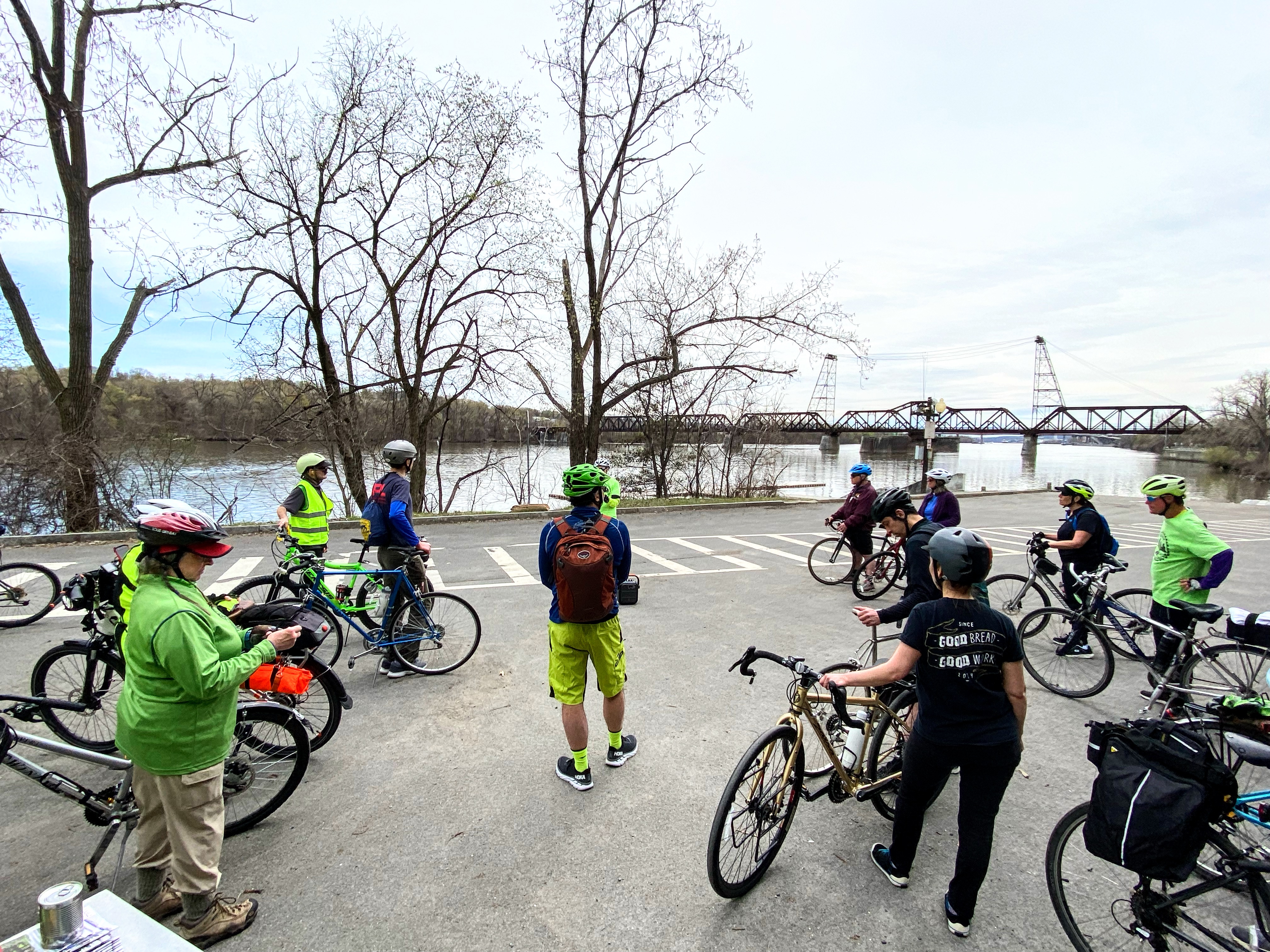
We finished sign-in by 1:00 PM on Saturday, April 23 at the Corning Riverfront Park Boat Launch. The group of 27 departed shortly after on a 10-mile round trip which was mostly flat and on mainly low-traffic streets and bike paths, all based on CapitalNYBikeMap.com. We had informative talks at the Livingston Avenue Bridge, the South End Connector multi-use path, Radix Ecological Sustainability Center, DGS recycling center, and the warehouse district. The ride lasted 2 1/2 hours.

Signing In

Pre-ride safety briefing

Here is the route on Google Maps (divided into 4 parts for easier viewing)
1. Mohawk Hudson Bike Hike Trail (MHBHT); South End Connector; Radix Center
2. Radix Center; South End Connector; MHBHT to Menands
3. Exit MHBHT using new “Village of Menands Bike Connector,” parallel to entrance ramps, to Broadway (Google Maps not yet updated to show Connector route).
4. Riverview Center; Broadway; Simmons Ln; Erie Blvd; warehouse district

On the home stretch

Leave a comment

Filed under Activisim, Climate Change, Earth Day

85-Percentile Rule

The 85-Percentile Rule is a guide for setting speed limits but one that must be used with a great deal of discretion to prevent creation of unsafe road and streets.

++++++

85-Percentile Rule – No, it’s not where you were on the math SATs but a way of setting speed limits on roads and streets. Departments of transportation define the 85-percentile speed as the speed at or below which 85 percent of all vehicles are observed to travel under free-flowing conditions. Traffic and Transportation Engineers use the 85th percentile speed as a guide to set the speed limit at a hopefully safe speed, minimizing crashes and promoting uniform traffic flow. Data are gathered using radar guns or other devices and then analyzed. Engineers take the observed speeds and eliminate the top 15 percent. The indicated speed is then at the 85-percent level (to the nearest 5 mph increment). This procedure – if the set speed is not excessively low – ensures that all drivers will be going at about the same speed with few opportunities for conflict. This, of course, means that 15 percent of the drivers are exceeding what the other 85 percent view as a comfortable and safe speed. So who is correct?

This is fine until the design speed and the posted speed are in conflict.

The Caveat – The catch is the “. . . speed at or below which . . . vehicles are observed to travel under free-flowing conditions.” When design speed – the speed that feels safe or comfortable for most drivers – markedly exceeds the posted speed, we are in trouble. Many people are comfortable driving faster than is safe for them and or comfortable for others especially when there are confounding factors. Those few who adhere to the posted speed will be passed where possible or “tailgated” when not. “Free flowing” also presents a problem if the rule is applied to streets that are, at times, free flowing but at others, not so much.

Built for 55 – Please go 30 MPH

Right Here, Right Now – A local poster child is Albany’s Washington Ave., an unnumbered State route. It was clearly built – designed – as a 55 mph road. Nonetheless, going outbound from Brevator St. to Rt. 155/New Karner Rd. it is posted at 30 mph (Brevator St. to Fuller Rd.) and 45 mph (after Fuller Rd.) These reduced speed limits are based on the increasing non-highway activity with University at Albany residences and crossing pedestrians, motels, medical and other offices, convenience stores, big-box shopping, social clubs, churches, the dump, and cross roads. There is talk of a massive rebuild of at least the Brevator-Fuller segment but no action to date.

Washington Ave. FLY over

So what went wrong? If we used the 85-Percentile Rule today with the current built up environment, one might guess that the speed thus suggested might well exceed 45 mph and certainly 30 mph. Just drive on it at the speeds posted currently to demonstrate this to yourself. Put another way, the world changed but Washington Ave. did not. We are in the 2000s, and it is in the 1950s. Rest assured that Washington Ave. is not the only such example in our area.

Death Alley – A similar situation is the so-called Cohoes Blvd. or Cohoes’s own “death alley.” Briefly, the State originally built I-787 to blast into the middle of Cohoes with ¾ of the city on the west side and ¼ on the east. The transition from interstate to city street was invisible with expected results. After many years and much pressure, the in-city portion was completely rebuilt featuring raised crosswalks or speed tables, lighting, a chicane, a multiuse side path, enhanced traffic control, a center median, turn lanes, and signage. When asked, a representative stated that NYSDOT would base the redesigned boulevard’s (new) speed limit on the 85-percentile rule. Coming into Cohoes, the posted speed is now 45 mph and then 35 mph. Whether or not drivers follow these limits is for others to judge.

Cohoes Blvd or I-787 – road, street, or stroad?

Driver Behavior – One source (https://www.youtube.com/watch?v=NDYQaa3K_BA ) posits that the change from a street to a road challenges drivers to “shift mental gears” from highway mode – which is more or less unconscious, intuitive, and automatic driving behavior – to being focused, observant, engaged, and deliberate. So how does one force fit driver behavior to street conditions?

Appropriate Use – For rural roads and with no countervailing data (e.g., excessive crash data, blind curves, schools, pedestrian and cyclist traffic, no shoulders, many entries/exits) the 85-Percentile Rule is probably a good first step. Note that the term here is “roads” not “streets.”

Inappropriate Use – When we get to a “street” the situation changes. A road is a high-speed connection to get from here to there with a simplified environment with minimal cross streets and driveways, and no accommodation for pedestrians or cyclists.

A street is a complex environment used by people where cars are guests that have to be caused to be on good behavior. A street is not intended for fast motor vehicles as a thoroughfare but a place where people go – the end point of a trip. Setting the posted speed limit based on car travel speeds does not seem like an appropriate application of the 85-percentile rule. In fact, it’s a “cart before the horse” to set the speed limit AFTER the street is built. A better option is to decide on the desired safe speed and THEN spec the design (or alter an existing design).

You cannot just ask for good behavior (e.g., “30 MPH” [please], “Share the Road” [please], “School Zone – 20 MPH” [please] ) you have to design out bad behavior. Drivers do not constantly adjust and re-adjust their speed based on the roadside signage. Instead, they cruise along at a comfortable rate (e.g., the design speed) partially based on what other nearby drivers are doing. The street’s DESIGN is a much more effective speed control than a sign buried with all the rest of the roadside garbage signs that transportation officials believe will offset inappropriate street design. The message from the street’s design is clear with no static; that from the sign (e.g., 30 MPH) has to force its way through a very noisy channel with dismal results.

Back to Our Sample – Washington Ave. becomes a street at roughly Brevator St./Rt. 85 heading toward downtown Albany. That is, the nature of the right of way changes from a road to a street with people, residences, schools, shopping, offices, churches, restaurants, and pedestrian/bicycle traffic. Put another way, Washington Ave. transitions from a road to a “stroad” – a thoroughfare that is neither a road nor a street. This is why, for example, 20 mph speed limits with vehicle speed displays in school zones are a failure – nothing in the road design says “slow down!” As an historical aside, Washington Ave. once had a center median but it was removed in the 1930s – too bad!

This is a street

They are INTRAstates – In many towns and cities in the USA with street layout dating to the 19th, 18th, and even 17th centuries, streets have become stroads with inappropriate outcomes for all concerned. Even with interstate highways – which have morphed into INTRAstate highways – motor vehicles entering or leaving cities have caused this “stroadization.” Cars come flying off 4-lane, high-speed roads (with a 4-lane, high-speed mentality) and are then faced with narrow, winding, people-filled streets with traffic lights, double-parked cars, snow piles, people trying to cross, squirrels, children going to school, and so on. Without proper STREET design, the result is chaos and, frequently, property damage, injury, or death. Albany, as but one example, is completely ringed and bisected by 4-lane, super highways – 787, 85, 90, NYS Thruway, and 87. Each both feeds traffic into the city but also is a goal for those leaving. “Drive time” has become “all the time.”

High car speeds intrinsically mean greater chances of injury or death for pedestrians or people on bicycles and compression of driver reaction time to the dynamic nature of a street. The solution? There has to be something that tells drivers that (1) the road (or highway) has now ended and (2) the street has now begun. These “somethings” can include narrowing of the road or travel lanes, speed tables or speed humps, vertical objects like trees, center medians, or chicanes.

This is a street. This is a human. That is a bicycle. That is a cross walk. That is an ADA curb cut.

Conclusion – The 85-percentile rule is a starting point for determining posted speed limits. It is probably appropriate for roads. It is the wrong rule when there are safety and social concerns that supersede the desire of people in cars to “get through here as fast as possible.” Streets are for people. Parks are for people. Intersection crossing are for people. Stores, restaurants, offices, apartments, and houses are for people. A traffic engineer who applies the 85-percentile rule to urban or suburban streets might consider a career shift.

++++++

Notes – Strong Towns coined the term “stroad” to explain dangerous, multi-lane thoroughfares that are in every city, town, and suburb. They are what happen when a street – a place where people interact with businesses and residences and where wealth is produced – is combined with a road (a high-speed route between productive places). https://www.strongtowns.org/journal/2018/3/1/whats-a-stroad-and-why-does-it-matter Strong Towns (https://www.strongtowns.org/about ) supports people across the United States and Canada who are advocating for a radically new way of thinking about the way we build our world.

Resources –

85th Percentile Speed Explainedhttp://www.mikeontraffic.com/85th-percentile-speed-explained/

Understanding the 85th Percentile Speedhttps://www.strongtowns.org/journal/2020/7/24/understanding-the-85th-percentile-speed

The Wrong Way to Set Speed Limitshttps://www.youtube.com/watch?v=bglWCuCMSWc

Leave a comment

Filed under Activisim, Editorial, Product Review, Washington Ave.