Commute by Bicycle – Book Review

The Bicycle Commuter’s Handbook* by Robert Hurst would make thoughtful gift for someone contemplating commuting by bicycle. This pocket/purse size book packs a lot of useful information into its 97 pages. However, an urban rider with 5-8 years of experience would enjoy this book as an entertaining refresher with some perhaps new ideas.

The included sections are “Equipment and Clothing,” “Preparation,” “The Ride,” “At Work,” and “Routine Maintenance.”

“Preparation” has some good thoughts on route planning based on different skills and riding preferences. Among tips that would be evident to an experienced rider but valuable to a newcomer is the observation that the most important ingredient for a bicycle friendly street is the attitude of the people who use it. Street features the author recommends avoiding include high traffic speeds, on-street parking, time-sapping traffic signals, oblivious pedestrians, interstate entrance/exit ramps, high schools(!), damaged road surfaces, and bad attitude or “street vibe.”Bicycle Commuter's Handbook 2013

Again for the prospective commuter, “The Ride” section has a number of tips to avoid trouble – better to read about them and be prepared rather than to discover that, for example, longitudinal cracks can get you in trouble.

One not so obvious observation in the “At Work” section is the attitude about cycling and cyclists commonly held by one’s non-cycling co-workers, subordinates, and supervisors. While the experienced cyclist already will have experienced this phenomenon, it might be “news” to the budding commuter the first time she clumps into the office in helmet with a messenger bag. The author notes that the USA never had a bicycle commuter culture, so forewarned is forearmed.

One helpful section covers diagnosing (and correcting) bicycle fit issues by the nature of the pain experienced. This and other straightforward bicycle fit tips are a break from what one might have read in articles that are more “technical.”

Overall, this is a nice little book – well written and well organized.

_ _ _ _ _
*Hurst, Robert, The Bicycle Commuter’s Handbook, (Guilford, CT), 2013, ISBN 978-0-7627-8468-4, US$12.95.

Leave a comment

Filed under Bike Tech, Comings and Goings

Right Turn of Death – Revisited

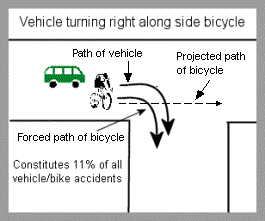
In the past three weeks, I’ve had four distinct “Right Turn of Death” experiences. Also known as the “Red Light of Death,” this is when a motor vehicle pulls alongside (or the cyclist pulls alongside the motor vehicle) and the motor vehicle then turns right cutting off or hitting the cyclist.

These instances are precipitated by one of two behaviors or their combination – motor vehicle operators who are simply not conscious of what they are doing and/or cyclists who have not learned from their own observations or from those of others – that being to the right of any motor vehicle at any intersection puts them at risk.

Here’s my recent score:

Case #1 – Forgot that she passed me about 60 feet back and pulled alongside at the red light.
Case #2 – Totally clueless (in moving traffic)
Case #3 – SUV rudeness (in moving traffic)
Case #4 – See #2 above (pulled alongside at a 4-way stop sign – then looked everywhere except at me)

All were on 2-lane streets in Albany.

Aside from being careful and mindful of your own surroundings, here are a couple suggestions when coming to an intersection at which you must stop and there are motor vehicles following you.

1. Take the lane
2. Take enough of the lane so that those following can see you but still get by – just angle your bicycle to the left as you put your foot on the pavement
3. Put a little wiggle in your ride as you come to a stop – they will think you are either nuts or going to fall over and will avoid you (trust me, it works)
4. Make eye contact with the driver next to you (so you are seen)

If you are moving and the motor vehicle operator passes and then turns into or in front of you and you cannot stop, execute a “quick turn” that will result in a miss or, at worst, a glancing collision with the side of the car.

Quick1

Leave a comment

Filed under Article, Feature

College of St. Rose Picks Up on ABC Position on Madison Avenue Traffic Calming

The College of St. Rose “Chronicle” nicely picked up on the Madison Avenue Traffic Calming letter ABC sent to Albany Police Department’s Traffic Engineering. ABC voiced support for the “traffic calming” proposals put forth but asked that the bicycle lanes be six (not five) feet wide. This sentiment was echoed in the article by recently re-elected (in the face of anti-bicycle lanes backlash) 10th Ward Common Council Member Leah Golby.

History buffs – and bicycle and pedestrian advocates looking for support for their own cause – will enjoy the comments by City Historian Tony Opalka about the “transposition powerhouse of the day” (the canal lobby) banning railroads from crossing the Great Western Turnpike (Western and Madison Aves.). If you ratchet up the dates to the present and the contenders (motor vehicle/big petro/big construction lobbies vs. cyclists and pedestrians) you’ll see that we are in the same fix today – those who have a right to locomotion are constrained by road and street design from exercising that right in safety.bike-in-traffic

The Text of the ABC letter follows:

Since April 16, 2013 when Creighton-Manning presented its suggested Madison Ave. “road diet” treatments for Madison Ave., the Albany Bicycle Coalition has considered many different approaches, and has concluded that there is only one that maximizes bicyclist safety, and would, therefore, encourage new cyclists. That approach is a modified “Option C” (in-road bicycle lanes), with the bicycle lanes widened to six feet to provide a sufficient safety margin.

By way of explanation, ABC’s goals remain firmly as follows:

• Calm Traffic on Madison Ave. – For the benefit of cyclists, pedestrians, transit users, and motorists.
• Make Madison Ave. the City’s Main East-West Bicycle Corridor – Of our three radial streets, only the Madison-Western Ave. combination offers all the desired benefits without negative impact on other street users. It has all the major destinations and connects easily with all major cross streets. With its expected continuation east to the river and west to Guilderland, it will be the heart of the long-needed “river-to-Fuller” bicycle route.

The consulting engineer’s Madison Ave. traffic calming study suggested only three options to meet the goals of that road diet. The suggested options (with ABC annotations) are as follows:

A. Shared Lanes in Travel Lanes – This option is unsuited to most cyclists. While shared lane have been installed elsewhere in the city to great benefit, their use on Madison Ave. would undercut the goal of its being a major route suited to cyclists of all skill levels.
B. Shared Lanes in Parking Lanes – This option seems to be used rarely elsewhere and exacerbates the potential for collisions between cyclists and opening doors of parked vehicles. ABC members who have ridden these “parking-bicycle lanes” found them unsuitable. This option should be considered only as a last resort.
C. Five-Foot Bicycle Lanes – This is the preferred of the three options. However, we believe that five-foot lanes would deter many would-be cyclists. The margin of safety with five-foot bicycle lanes is just not sufficient.

Thus, these three options have extremely limited potential for bringing new cyclists onto the streets. Options A and B might be suitable for experienced cyclists, but those cyclists are already accustomed to riding on streets with no bicycling features at all.

The overarching goal for the City of Albany is to build cycling infrastructure that will attract current non-riders, as well as those who hesitate to ride on the street with motorized traffic. Only by working toward this goal can we realize lower pollution, more parking, less traffic congestion, more public safety, improved health, and increased pedestrian use of the streets.

Consistent with that goal, our position is that a modified Option C – with wider bike lanes – is the best way to bring about the city’s objectives:

• The consulting engineer’s Option C consists of five-foot bicycle lanes located at the right side of the travel lane, adjacent to the parking lane.
• However, based on our extensive experience, five feet is not sufficient to protect cyclists from car doors, and from wide commercial vehicles parked at the curb.
• Therefore, we propose that the bicycle lanes be a minimum of six feet wide. Our design obtains the extra two feet (total) by subtracting approximately eight inches from each of the three motor vehicle drive lanes.

These modifications are feasible and justifiable. They vastly improve the safety of Option C, and they preserve the intent of the consulting engineer’s proposal. If implemented, they will provide a safe, inviting, Madison-Western east-west bicycle corridor that the city needs in order to become a real bicycling community.

We look forward to working with you and other project staff and supporters to realize the development of the Madison Ave. bicycle route.
Leave a comment

Filed under Activism, Bicycle Boulevards, City Review, Support the Cause

Bicycling Means Business – Madison Avenue Traffic Calming

Bicycling Means Business Study Facts & Figures
Testimony before the City of Albany Common Council on Madison Avenue Traffic Calming
11-4-13
Provided by Becky Puritz

Along San Francisco’s Valencia St. two-thirds of merchants said that new bike lanes had a positive overall impact on their business. Two-thirds of the merchants also supported more traffic calming measures on the street.

A 2009 study of Bloor St., a commercial street in Toronto, Ontario showed that encouraging bicycling is good for business: people who had biked and walked to the area reported that they spent more money in the area per month than those who drove there. The study concluded that the addition of bike lanes would be unlikely to harm local business and predicted that commercial activity on the street would increase. ???????????????????????????????

In Memphis, TN, bicycle lanes are part of the city’s Broad Avenue Arts District initiative. Since the beginning of the project, the district has seen 16 new businesses, 29 property renovations (17 at blighted locations), and 40,000 visitors to the Arts Walk. Restaurants have reported a growth in business from bicycle riders.

Moore’s Bicycle Shop in Hattiesburg, MS saw a dramatic spike in sales after the Longleaf Trace multi-use trail was built in 1994. As a direct result of this investment in their local community, that one small business has generated an additional $175,000 in sales tax for the state, of which $31,500 (18 percent) was returned to the city of Hattiesburg.

Bike facilities can also have positive, statistically significant impacts on home values. A study of home values near the Monon Trail in Indianapolis, Ind. measured the impact of the trail on property values while controlling for other variables. Given two identical houses, with the same number of square feet, bathrooms, bedrooms, and comparable garages and porches one within a half mile of the Monon Trail and another further away the home closer to the Monon Trail would sell for an average of 11 percent more.

And in our very nearby Manhattan, protected bicycle lanes on 9th Ave. led to a 49 percent increase in retail sales at local businesses along the bike lane, compared to just 3 percent borough-wide. In addition, 49 percent fewer commercial vacancies along Union Square North and 47 percent fewer along 1st and 2nd Avenues after bike lanes, compared to 5 percent more borough-wide. (SOURCE: New York City Department of Transportation. Measuring the Street: New Metrics for 21st Century Streets. NYC, 2012)

I don’t think the question should be whether we can afford the Madison Avenue Traffic Calming project, but rather is whether we can afford not to do it.

Cycling - Madison 8-16-13 COMP

[The source for much of this information is the League of American Bicyclists article.]

Leave a comment

Filed under Article

See and Be Seen

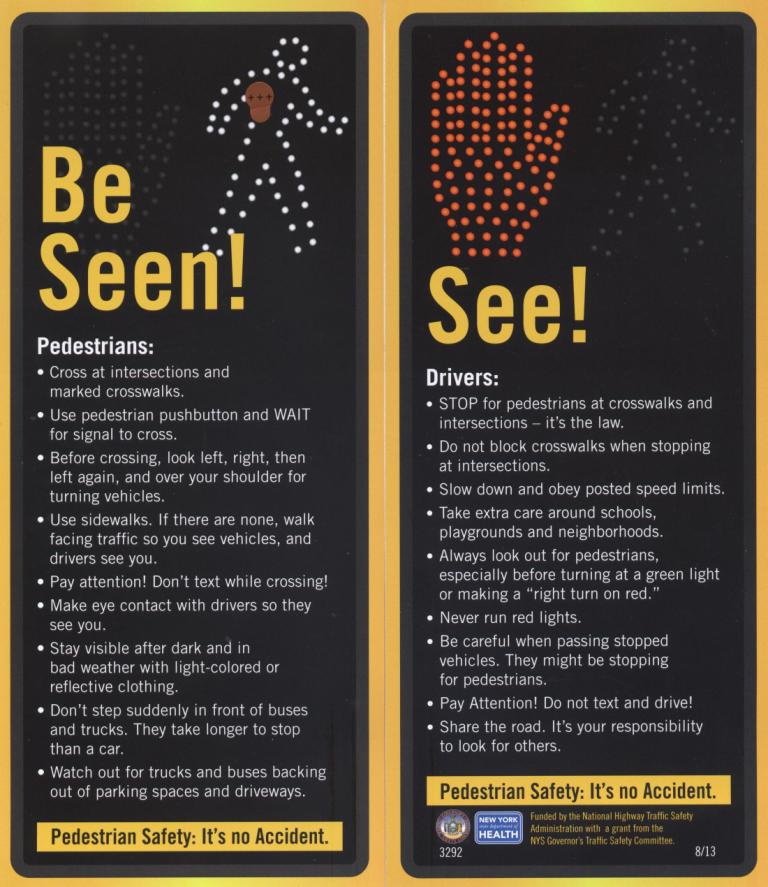
See and Be Seen 10-31-13 001The City of Albany and the Albany Police Department, in cooperation with the Governor’s Traffic Safety Committee, the NYS Department of Health and neighboring municipalities, have initiated a traffic safety campaign – “See and Be Seen.”

Amongst other features, the program involves promotional literature and posters carrying basic messages for motor vehicle operators and pedestrians. The recent spate of pedestrian injuries and deaths on Central Ave. and other streets prompted this campaign.

Heavy Traffic 10-31-13

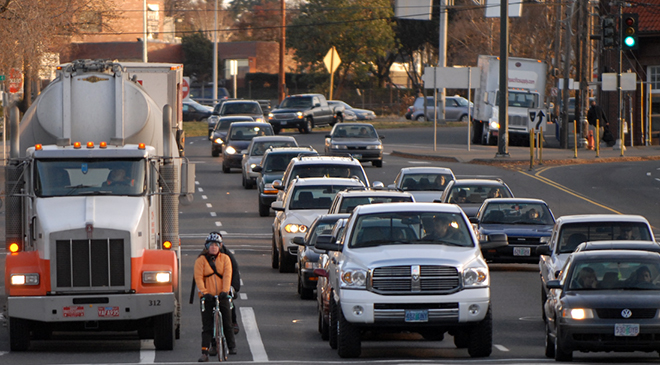
The reminders are good for both experienced cyclists and drivers – the overall message is, as always, be considerate of other road users.

Just a warning . . . this time . . .  10-31-13

Leave a comment

Filed under Activism, City Review