Category Archives: Activism

What’s the Rush?

In December 380 years ago, Harmen Myndersz van den Bogaert set out by foot for Mohawk country to reaffirm a beaver pelt relationship on behalf of the Dutch West India Company. He and his buds, Willem Thomassen and Jeronimus dela Croix, probably followed a path not far from Route 5S and eventually walked almost to Lake Ontario.

In October, 106 years ago, the 1909 Model T rolled off the Piquette Avenue Plant line in Detroit.

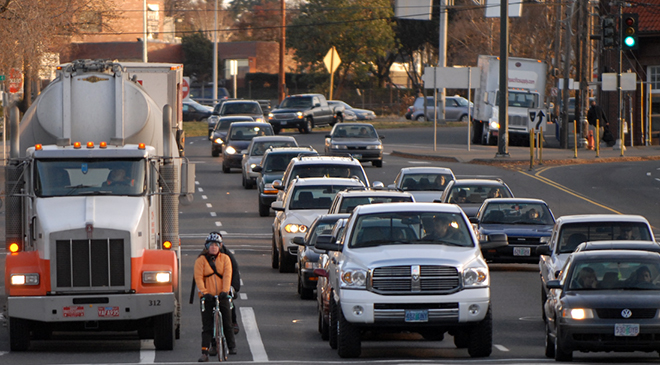
In October 8 years ago, a car ran down Alan Fairbanks, 72, while he was crossing Route 5S to continue cycling on the Mohawk-Hudson Bike-Hike Trail. Al died in hospital a month later. The photo shows his daughter and grandson setting up Al’s ghost bike. OLYMPUS DIGITAL CAMERAAl was an experienced cyclist. The precise nature of the collision was never clear. Those who know this highway-trail crossing will attest to its danger. A posted 55 mph would be a minimum.

In both cases, although for different reasons, all these men were going about their business in the Mohawk River Valley.

In May 6 years ago, the Daily Gazette reported that Al’s ghost bike appeared “. . . on the trail the same week Rotterdam officials unveiled the Exit 26 and Interstate 890 land-use and transportation study. An outpouring of concern brought the trail crossing to the forefront of the Capital District Transportation Committee-funded study, even though it wasn’t an intended focus. ‘It’s a bad intersection,’ said Peter Comenzo, the town planner.”OLYMPUS DIGITAL CAMERA

Today, April 1, 2014, the Albany Times Union reports plans to improve safety by altering the Mohawk Hudson Bike/Hike Trail that runs along this section of Route 5S. Schenectady County plans to spend $148,000 on the project. The County will realign the crossing of the roadway and slow trail (but not highway?) traffic as it approaches the crossing. It will include signs on the trail and roadway to alert travelers. Follow the Times Union link for photos and for information on the public hearing.

Other ghost bikes in the area include the following: Matthew Ratelle – December 20, 2012 (age 40, bicyclist killed by impaired driver, on Rt. 22, Petersburg), Paul J. Merges, Jr. – November 24, 2012 (age 45, bicyclist killed by pickup truck/drunk driver, on Manning and Roosevelt, Albany), Nicholas Richichi – October 19, 2007 (age 53, bicyclist killed by motor coach, Fuller Rd., Colonie), Diva De Loayza – June 6, 2007 (age 40; bicyclist killed by car, on Western Ave. at Homestead, Albany), Jose Perez – August 3, 2006 (age 60; bicyclist killed by SUV on Broadway at Quay St., Albany.), Joel Melnikoff – July 3, 2006 (age 49; bicyclist killed by car/drunk, Rt. 32, Bethlehem), David Ryan – June 29, 2004 (age 32; bicyclist killed by car/reckless driver on Riverview Rd., Rexford), and Robert F. Zayhowski – July 16, 2000 (age 43; bicyclist killed by SUV/drunk driver on Rt. 66, Sand Lake). (Notably, at least four of these fatalities were caused by “perps” on drugs, alcohol, or both.)

So . . . whats’ the rush?

Leave a comment

Filed under Activism

Promoting the Pedestrian/Bicycle Pathway ~ Livingston Avenue Railroad Bridge

OAlbany Bicycle Coalition is a long-time supporter of the re-establishing a pedestrian/bicycle pathway over the to-be-built Livingston Avenue Railroad Bridge. ABC has joined with the Livingston Ave. Rail Road Bridge Coalition and other organizations to support this critical river crossing to include writing to the Governor as follows:

The Honorable Andrew M. Cuomo
Governor of New York State
State Capitol Building
Albany, NY 12224

Dear Governor Cuomo:

The planned rebuilding of Albany’s Livingston Avenue Railroad Bridge presents a one-time, unique opportunity to provide a pedestrian and bicycle link between both sides of the Hudson River.

Within a very short time, Amtrak, NYSDOT, and other organizations must begin work to replace this aging but critical rail link. We in the Albany Bicycle Coalition, on behalf of pedestrians and cyclists in the Capital Region, are asking your support for one small but key provision: restoration of a walkway/bikeway on the new bridge.

The numerous pedestrian and cycling projects underway throughout the Capital Region will benefit enormously, when connected together by this vital link. One can easily envision both recreational and commuter bicyclists using the link to decrease traffic congestion, promote tourism, reduce pollution, and increase health.

The cost of this minor augmentation to the bridge will be minimal within the project’s scope. By contrast, its impact on economic development, recreation, and environmental quality, will be great and lasting. Local governing bodies and planning commissions have fully endorsed this project, as has Senator Schumer.

We urge your involvement to ensure that residents, commuters, and tourists on both sides of the river can once again have a convenient and safe crossing over the Hudson.

Leave a comment

Filed under Activism, City Review, Local Bike Rides

Bicycle Bozo of the Year Award ~ Thomas Barraga

Bicycle Bozo of the Year Award ~ Thomas Barraga

Suburban NY Lawmaker: Ban Bicycling on Long IslandBozo the Clown

The Times Union ran an AP story on February 14, 2014 reporting tasteless and discriminatory comments by my candidate for “Bicycle Bozo of the Year.” Suburban lawmaker “ . . .says it’s too dangerous for people on eastern Long Island to ride bicycles or motorcycles on the street. Suffolk County legislator Thomas Barraga made the claim in a letter to the son of a Long Island woman who was injured by a car while bicycling. Wikipedia reports that he stated in the letter “no one who lives in our hamlet or for that matter Suffolk County should ever ride a bicycle or motorcycle.” Barraga goes on to state that signage and bike lanes would do little to solve the problem, since motorists ignore signs anyway. “Reality at times can be difficult for some to come to grips with but giving false hope would be inappropriate.”

Our own Josh Wilson, executive director of the New York Bicycling Coalition says cycling fatalities in Suffolk made up almost 20 percent of the state’s total.

Here’s the whole text from People for Bikes:
January 29, 2014

Dear Mr. Cutrone
Thank you for your recent letter concerning bicycle safety and bicycle lanes. Let me at the outset express the hope that you mother will have a complete recovery from her accident in September while riding a bicycle in West Islip.
I have lived in West Islip most of my life and my personal feeling is that no one who lives in our hamlet or for that matter in Suffolk County should ever ride a bicycle or a motorcycle. I cannot tell you how many constituents over the years have told me that they are taking up bicycling for pleasure and exercise. I have told them not to do so but they usually do not listen – 90 percent of those people eventually were hit by an automobile many like your mother with serious physical injuries.
I have heard the suggestion of bicycle lanes and additional signage but unfortunately this would do little to solve the problem. Suffolk County is a suburban automobile community—drivers expect to see other drivers on the road not bicyclists and motorcyclists. Even in those areas outside of Suffolk County where a portion of the road is for bicyclists—they still get hit by motorists. Signage has limited effects—there are currently 135 signs between Montauk Highway and Sunrise Highway on Higbie Lane and Udall Road—most of them are ignored by drivers.
Reality at a time can be difficult for some to come to grips with but giving false hope would be inappropriate.
Signed: Thomas Barraga

1 Comment

Filed under Activism, Editorial

Chow Down – Cranksgiving 2013

??????????????????????Saturday’s freezing, windy, snowy evening was a good reminder of the plight of those who lack warm clothing, a bicycle, money to feed themselves, and a warm place to which to return after a “night on the streets” of Albany.

Twenty-three riders showed up at 7 PM for 2013’s Cranksgiving Alley Cat “race” – an international event that gives riders a chance to have some fun while helping others.

Armed with shiny new spoke cards, we started with a quick run from the Soldiers and Sailors Monument in Washington Park to the Price Chopper on Madison and then returned to the Monument for a new manifest. The “A manifest” riders collected canned goods and extras. The “B” riders carried a juice/soda from each stop and the other extras. (We even hit a 2-for-1 special on potato chips.)

Snow flurries with 20-degree temperatures were augmented by a steady west wind as we then headed straight into the wind and snow toward the Westgate Plaza and Colvin Ave. for combined stops (thank you Jay and Stacy for combining these) at Hannaford and Price Chopper. While still freezing and with some slippery spots on the pavement, it was back to the Monument to unload and pick up the last manifest for a short crosswind ride to the Delaware Ave. Price Chopper. Riders assembled at the Madison Café at Swan to complete filling the boxes and then helping load the Homeless Action Committee (HAC) van. We had seven large size boxes plus two more in Stacy’s truck for later drop off. The average spent was $19 which equals $437 or about 200 lbs of food donated to HAC. Many hands make light work!Comp

Our ride leaders presented us each with an embossed Cranksgiving pint glass, a nice memento of a great evening. Everyone had a good time and will hopefully return for next year. It is nice to see riders come out and ride to help those without and recovering from addiction. Riders were indebted to Jay and Stacy for a well-organized event and particularly to Stacy who staffed the pickup vehicle at the Monument. Thanks to everyone. We are always open to ideas and future volunteers for 2014.

At 9 PM, it was time to face the wind again and head back to a warm house.

Leave a comment

Filed under Activism, Fundraising, Rides

College of St. Rose Picks Up on ABC Position on Madison Avenue Traffic Calming

The College of St. Rose “Chronicle” nicely picked up on the Madison Avenue Traffic Calming letter ABC sent to Albany Police Department’s Traffic Engineering. ABC voiced support for the “traffic calming” proposals put forth but asked that the bicycle lanes be six (not five) feet wide. This sentiment was echoed in the article by recently re-elected (in the face of anti-bicycle lanes backlash) 10th Ward Common Council Member Leah Golby.

History buffs – and bicycle and pedestrian advocates looking for support for their own cause – will enjoy the comments by City Historian Tony Opalka about the “transposition powerhouse of the day” (the canal lobby) banning railroads from crossing the Great Western Turnpike (Western and Madison Aves.). If you ratchet up the dates to the present and the contenders (motor vehicle/big petro/big construction lobbies vs. cyclists and pedestrians) you’ll see that we are in the same fix today – those who have a right to locomotion are constrained by road and street design from exercising that right in safety.bike-in-traffic

The Text of the ABC letter follows:

Since April 16, 2013 when Creighton-Manning presented its suggested Madison Ave. “road diet” treatments for Madison Ave., the Albany Bicycle Coalition has considered many different approaches, and has concluded that there is only one that maximizes bicyclist safety, and would, therefore, encourage new cyclists. That approach is a modified “Option C” (in-road bicycle lanes), with the bicycle lanes widened to six feet to provide a sufficient safety margin.

By way of explanation, ABC’s goals remain firmly as follows:

• Calm Traffic on Madison Ave. – For the benefit of cyclists, pedestrians, transit users, and motorists.
• Make Madison Ave. the City’s Main East-West Bicycle Corridor – Of our three radial streets, only the Madison-Western Ave. combination offers all the desired benefits without negative impact on other street users. It has all the major destinations and connects easily with all major cross streets. With its expected continuation east to the river and west to Guilderland, it will be the heart of the long-needed “river-to-Fuller” bicycle route.

The consulting engineer’s Madison Ave. traffic calming study suggested only three options to meet the goals of that road diet. The suggested options (with ABC annotations) are as follows:

A. Shared Lanes in Travel Lanes – This option is unsuited to most cyclists. While shared lane have been installed elsewhere in the city to great benefit, their use on Madison Ave. would undercut the goal of its being a major route suited to cyclists of all skill levels.
B. Shared Lanes in Parking Lanes – This option seems to be used rarely elsewhere and exacerbates the potential for collisions between cyclists and opening doors of parked vehicles. ABC members who have ridden these “parking-bicycle lanes” found them unsuitable. This option should be considered only as a last resort.
C. Five-Foot Bicycle Lanes – This is the preferred of the three options. However, we believe that five-foot lanes would deter many would-be cyclists. The margin of safety with five-foot bicycle lanes is just not sufficient.

Thus, these three options have extremely limited potential for bringing new cyclists onto the streets. Options A and B might be suitable for experienced cyclists, but those cyclists are already accustomed to riding on streets with no bicycling features at all.

The overarching goal for the City of Albany is to build cycling infrastructure that will attract current non-riders, as well as those who hesitate to ride on the street with motorized traffic. Only by working toward this goal can we realize lower pollution, more parking, less traffic congestion, more public safety, improved health, and increased pedestrian use of the streets.

Consistent with that goal, our position is that a modified Option C – with wider bike lanes – is the best way to bring about the city’s objectives:

• The consulting engineer’s Option C consists of five-foot bicycle lanes located at the right side of the travel lane, adjacent to the parking lane.
• However, based on our extensive experience, five feet is not sufficient to protect cyclists from car doors, and from wide commercial vehicles parked at the curb.
• Therefore, we propose that the bicycle lanes be a minimum of six feet wide. Our design obtains the extra two feet (total) by subtracting approximately eight inches from each of the three motor vehicle drive lanes.

These modifications are feasible and justifiable. They vastly improve the safety of Option C, and they preserve the intent of the consulting engineer’s proposal. If implemented, they will provide a safe, inviting, Madison-Western east-west bicycle corridor that the city needs in order to become a real bicycling community.

We look forward to working with you and other project staff and supporters to realize the development of the Madison Ave. bicycle route.

Leave a comment

Filed under Activism, Bicycle Boulevards, City Review, Support the Cause