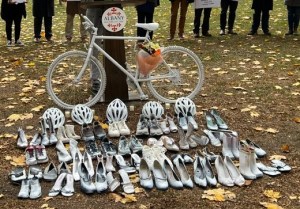
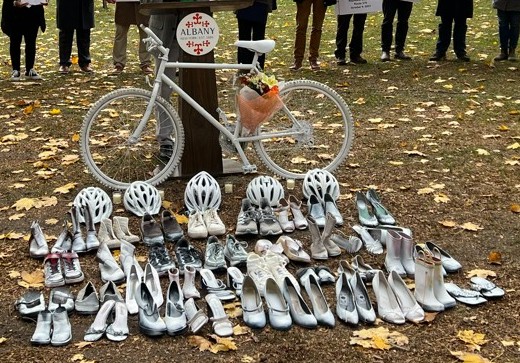
Sadly, it was recently reported that a man died when an e-bike he was riding was involved in a crash with a motor vehicle on Clinton Avenue. The crash happened Sunday, January 3rd at 1:10am. We wish to express our sorrow to this man’s family and friends for their loss.
We do not know the specifics of the crash at this time, however, it can be said that such tragedies are happening with greater frequency. A draft study released by NYS Assemblyman Alex Bores claims that in NYC, the number of collision fatalities per e-bike is 19 times greater than the number of collision fatalities per [standard] bicycle. With automobile prices and the cost of living through the roof, more and more people are turning to e-bikes and similar devices as a cheaper, logical transportation alternative. Unfortunately, there is a poor understanding of their dangers and the laws regarding which devices are legal, where they may be used, who may use them and how they may be used. Unfortunately, we can expect more crashes and more controversies regarding “e-bikes” in the year to come.
With respect to their dangers, first we need to point out that many serious crashes and complaints do not arise from legal “bicycles with electric assist” as defined by the Vehicle and Traffic Law. Outside of NYC, only Class 1 and Class 2 bicycles with electric assist may be legally operated. The motors of these devices are supposed to stop propelling the e-bike at 20 mph (NY VTL § 102-C). Devices resembling e-bikes, but going faster are either Class 3 (which may legally be used only in NYC and propel up to 25 mph) or some sort of “e-moto” device which may not be legally used on our roads unless they are recognized by the Department of Motor Vehicles as limited use motorcycles (aka mopeds) or actual motorcycles – both of which have many requirements including licensing & registration.
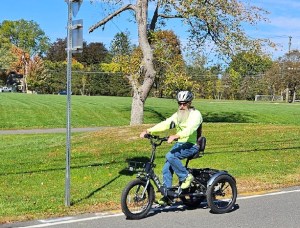
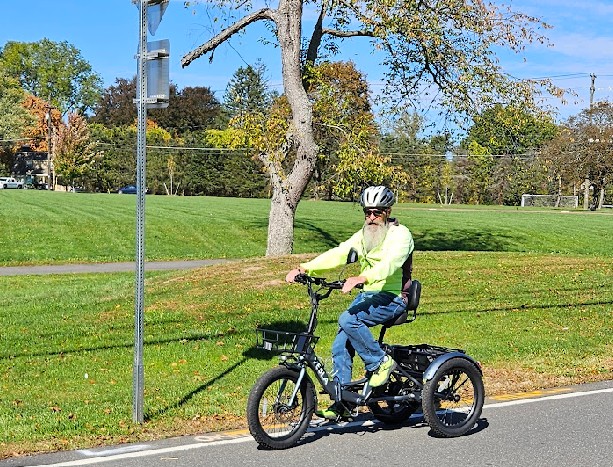
Author, Ed Brennan, Testing An E-Trike
One thing in common to all these devices is they accelerate much faster than the average bicyclist can accelerate a standard bicycle. Their cruising speed is also typically much greater than most riders can maintain. They are heavier and don’t stop and handle like standard bicycles. These issues often catch new e-device riders off guard and lead to crashes – including many crashes involving no other vehicle. Wearing a helmet while using an e-bike is strongly recommended (and required in Albany County). The faster and heavier the device, the more kinetic energy that will go into a crash and the greater the likelihood of serious injury and even death. This is especially true for many of those faster, illegal e-moto devices mistakenly called e-bikes.
It is important to note that none of these devices have the potential deadly kinetic energy of cars and trucks which are many times more massive and typically go much faster. Crashes involving e-bikes and pedestrians can result in a serious or fatal injury to the pedestrian – but such results are not anywhere near as likely as a crash between a car or truck and a pedestrian. However, e-bike riders themselves are more likely to be injured in crashes than the occupant of a car or truck because riders are not surrounded by steel and safety systems.
With respect to pedestrians, there are many complaints about e-bike riders on sidewalks. In NY it is not legal to operate a bicycle with electric assist on a sidewalk unless it is specifically permitted by local law (VTL § 1242 (5)). Albany recently changed its local law to allow standard bicycles to use sidewalks at a speed of no more than 5 mph and no riding within 5 feet of a pedestrian. Bicycles with electric assist and e-scooters were specifically prohibited from sidewalk riding by the Albany local law.
Another dangerous problem is the use of these devices by children. Nobody under the age of 16 is permitted to operate a bicycle with electric assist (or an e-scooter) in the State of New York. (VTL § 1242 (2)). These are not toys. Youngsters typically lack respect for how dangerous these devices can be.
Generally, e-bikes must follow the laws of standard bicycles, but there are special e-bike laws that many people don’t know, for example:
- They may not be used on roads that are over 30 mph unless permitted by the locality VTL § 1242 (8)
- Riders must ride in single file, they many not ride in tandem like standard bicycles VTL § 1242 (7)
- Operation under the influence of drugs or alcohol is prohibited VTL § 1242-A
- They may not be used in on public lands other than roads (like parks) unless permitted by the locality VTL § 1242 (4)
To make matters more confusing, local laws are also evolving so that legality may change from one municipality to the next. After growing complaints, NYC reduced the speed limit for e-bikes and e-scooters to 15 mph. Locally, after some complaints, Clifton Park held a town board meeting to discuss local regulation of e-bikes in Town Parks.
At this time the Governor of New Jersey is considering requiring licensing and registration for e-bikes of all classes. Expect more e-bike law proposals and changes on the state and local level in 2026.
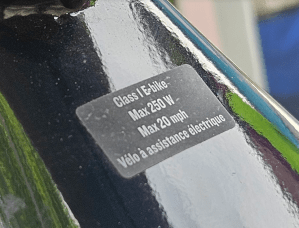
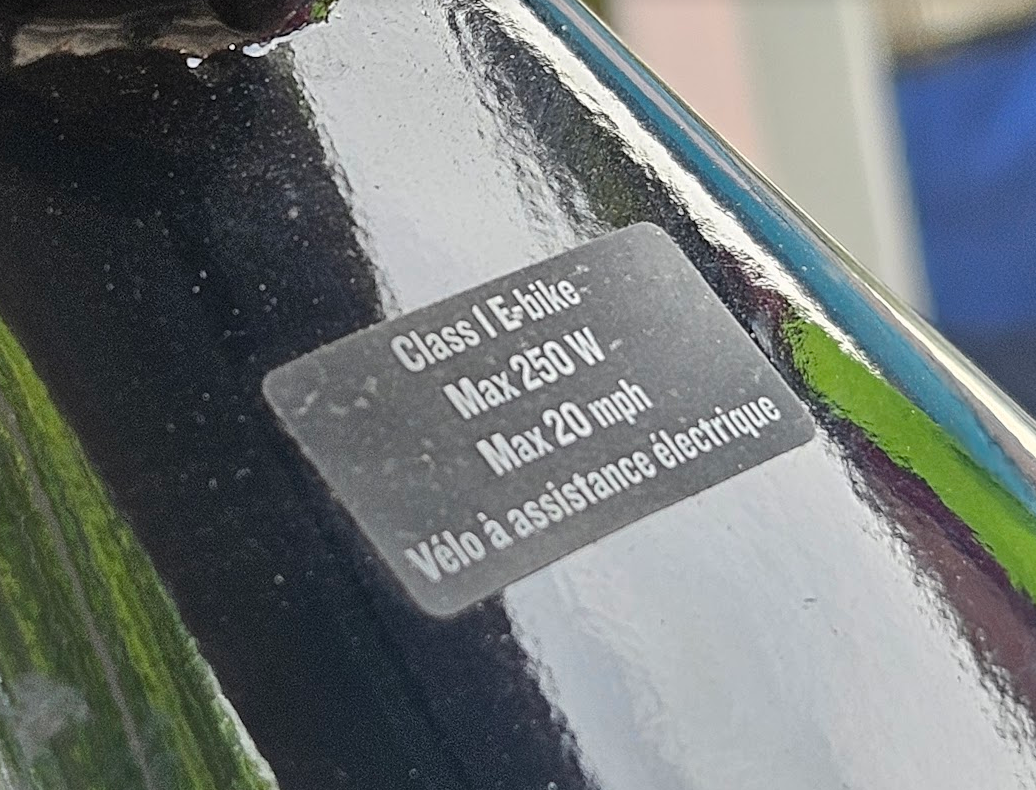
NY Law Requires A Label with Class, Max Speed and Wattage
Lastly, if you are going to purchase an e-bike – make sure it is legal to operate it where you intend to ride it. For instance, class 3 e-bikes can be purchased locally and online – but may not be legally operated outside of NYC.

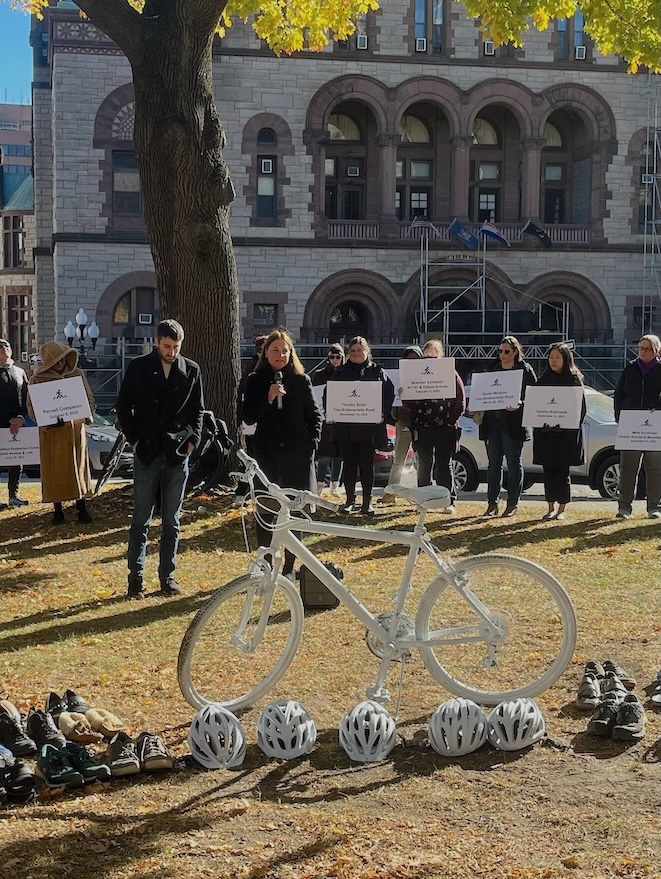







 Albany Bicycle Coalition