Monthly Archives: December 2011

Why Bicycle Boulevards?

Why do we need to bring bicycle boulevards to Albany?

Here are a list of statistics from Bike Belongs of why we need to bring bicycle boulevards to Albany.

  • After two streets in Minneapolis were converted to be more bicycle friendly, bike traffic increased 43%, total vehicle crashes decreased, traffic efficiency was maintained, and parking revenues remained consistent.

City of Minneapolis, 2010
Hennepin and 1st avenues two-way conversion leads to fewer crashes, better access

  • When protected bike lanes are installed in New York City, injury crashes for all road users (drivers, pedestrians, and cyclists) typically drop by 40% and by more than 50% in some locations.

Wolfson, H., 2011
Memorandum on Bike Lanes, City of New York, Office of the Mayor, 21 March 2011

  • Cities with high bicycling rates tend to have lower crash rates for all road users.

Marshall, W., and N. Garrick, 2011
Evidence on why bike-friendly cities are safer for all road users, Environmental Practice, 13, 1

  • The majority of bicycle-vehicle crashes are not a result of environmental factors, eg. darkness, fog, or rain.

Schramm, A., et al., 2008
How much does disregard of road rules contribute to bicycle-vehicle collisions? in Proceedings of high rish road users- motivating behaviour change: what works and what doesn’t work? National Conference of the Australian College of Road Safety and the Tra

  • A survey of 1,600 cyclists from Texas revealed that 70% of riders felt bicycling is dangerous in terms of traffic accidents, but only 21% thought it is dangerous in the context of crime.

University of Texas at Austin News, 2008
“State Bicycle Survey Reveals Danger Concerns, Cycling Perceptions”

  • Major streets without bike facilities are where the most bike crashes happen, followed by minor streets without facilities, bike paths, and then bike lanes.

Moritz, W., 1997
Survey of North American bicycle commuters: Design and aggregate results, Transportation Research Record: Journal of the Transportation Research Board, 1578, 91-101

  • Bicycle safety improvements attract proportionately more people to bicycling than automobile safety improvements (i.e. a 10% increase in safety results in a greater than 10% increase in the share of people bicycle commuting).

Noland, R., 1995
Perceived risk and modal choice: Risk compensation in transportation systems, Accident Analysis & Prevention, 27, 503-521

  • Between 2007 and 2008, overall bicycle use in Portland, Oregon increased 28%.

City of Portland Office of Transportation, 2008
Portland Bicycle Counts 2008

  • In Portland, OR, 2008 total traffic fatalities were the lowest in recorded history, with only 20 total fatalities, none of them cyclists. 2008 car, pedestrian, and cyclist fatalities were all at all-time lows.

Ciy of Portland, 2009
2008 Fatality Summary

  • The more cyclists there are, the safer cycling is.

Jacobsen, P., 2003
Safety in numbers: more walkers and bicyclists, safer walking and bicycling, Injury Prevention, 9, 205-209

  • Even though 85% of Amsterdam residents ride a bike at least once a week, only 6 or 7 cyclists are killed in traffic accidents every year.

City of Amsterdam, 2003
in “Cycling to sustainability in Amsterdam,” Buehler, R., and J. Pucher, Sustain, 21, Fall/Winter 2010

  • Higher actual crash risk increases perceived crash risk, while higher perceived crash risk is negatively associated with actual crash rates.
Cho et al., 2009
The role of the built environment in explaining relationships between perceived and actual pedestrian and bicyclist safety, Accident Analysis & Prevention, 41, 692-702

Leave a comment

Filed under Bicycle Boulevards

Windchill Effect While Riding a Bicycle

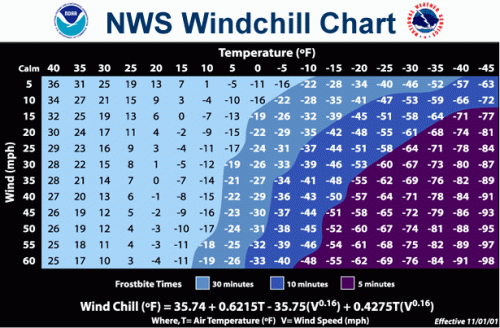
Two days ago I was on a six mile ride at around 6:45 am. It was about 20 degrees Fahrenheit.  Around 4 miles into my ride I noticed my hands were so cold. I started to wonder if my hands were cooler than the air temperature. According to the information below – my hands did feel colder and I wasn’t far off frostbite!

The US Department of Heath and Human Services says,

The Wind Chill index is the temperature your body feels when the air temperature is combined with the wind speed. It is based on the rate of heat loss from exposed skin caused by the effects of wind and cold. As the speed of the wind increases, it can carry heat away from your body much more quickly, causing skin temperature to drop. When there are high winds, serious weather-related health problems are more likely, even when temperatures are only cool.

Here’s a chart from the National Weather Service to help you understand the temperatures your body will be facing while riding.

NWS Windchill Temperature Index

Remember windchill effects while riding. Make sure you keep conscious of frostbite and how easy it can settle in. We don’t want to see anyone loose their fingers or toes! You can read our article here about layering properly.

Leave a comment

Filed under Winter Cycling

Winter Riding: Layer Up!

Coming in from a ride this morning I felt the cold. I left my Madison Ave apartment at about 6:45am. By the time I had finished my 6 mile journey my hands were totally immobile. Frozen. Once inside, I held them under running cool water to warm them up. Then it happened. They started to ache, it was terribly painful. Like the bones were rotting. Luckily it was just my hands that were cold. I had made the correct moves to keep the rest of my body warm with layers.

Take this knowledge about layers and stay warm this winter while riding.

Core – Base Layer or Wicking Layer

This goes back to fibers that can wick or that are hydrophilic. Get a base layer that is skin tight (looks good too!) and is made of a material that will wick water off your skin.  You want the article to wick so the sweat will be pulled off your body and skin tight to cover as much surface as possible. The oxford dictionary says that fibers will, “[have] a tendency to mix with, dissolve in , or be wetted by water.”  Anything with wool will wick.

Core – Mid Layer or Insulation Layer

You can spend lots of money on expensive garments, but a wool sweater is a great insulator. Yesterday I biked about five miles to Crossgates Mall. To keep me warm I had a t-shirt, wool sweater, and a relatively thin jacket on. It was about nine AM and cold. By the time I got to the mall I felt like I had just finished a 26 mile marathon through the Congan jungle. I was so hot and sweating all over. People were looking at me cross eyed. I felt happy to be warm. So try it out. Wear a wool mid layer.

Properties of wool according to the American Sheep Industry

Core – Outer Layer or Elemental Shell

Every survivalist needs a shell. Whales have their fat and elephants have thick skin. If you’re going to take on the winter you need a shell. You need something that is water proof. This will also break the wind. Windchill can make it feel much colder than it really is. On a bicycle, winds are inevitable. While riding in twenty degree still air, a ride at 15 mph can drop from twenty to six degrees according to the National Weather Service. Now factor in headwinds and frostbite is more serious.

Final Notes – Layer Smart

Use a wicking layer as a base layer.

Have a thick insulation layer as your mid layer.

An Elemental Shell is your outside layer.

Keep your hands warm with solid pair of gloves. Think the same with your feet.

Your face needs to stay warm too – look to ski wear. They have dealt with many of these problems since day one.

Here are some useful links to quickly pick up some winter cycling gear.

Aero Tech Design – good list of quality products

Primaloft’s products, as I have had very good experiences with their products in harsh conditions. Their different fibers are warm, breathable, mange water well, and some materials are even recycled materials.

Safe Riding. Here’s a link that reviews some of the better winter cycling gloves from bikeradar.com

Written by Daniel Patterson

4 Comments

Filed under Article